
A fire pump without proper installation cannot deliver the required protection, even if the pump itself complies with the highest technical specifications. An error in site location, pipe connections, or control panel calibration can leave the entire system vulnerable to failure right when the building needs protection. Therefore, the fire pumps installation guide is not merely about placing the unit inside a dedicated room, but encompasses a series of interconnected engineering steps starting from site assessment and concluding with operational performance testing and official civil defense approvals.
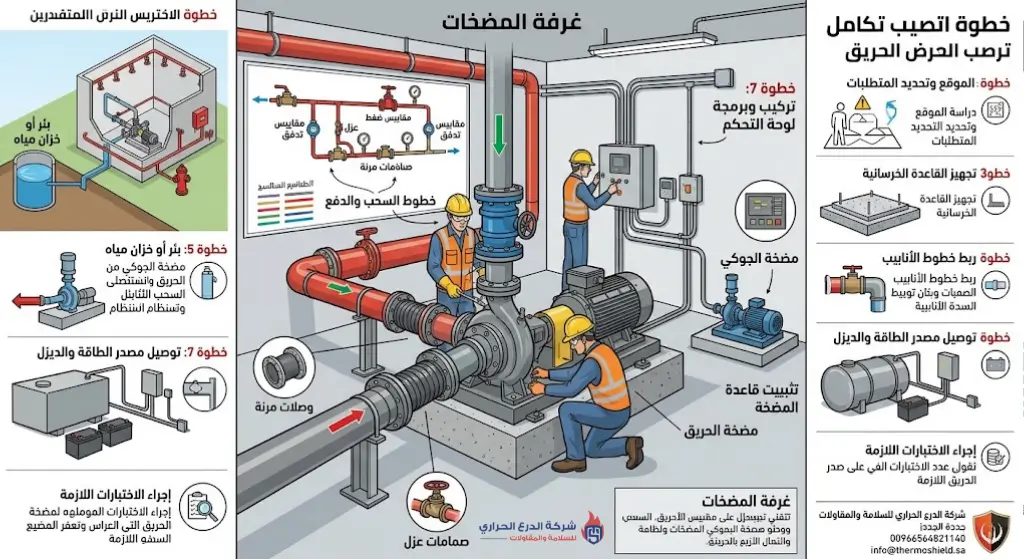
Table of Contents
- What is Fire Pumps Installation?
- What are the Practical Steps for Installing Fire Pumps?
- What Components Must be Considered During Fire Pump Installation?
- What Codes and Standards Govern Fire Pumps Installation?
- What are the Types of Fire Pumps Based on Installation Configuration?
- What are the Common Mistakes During Fire Pump Installation?
- When Does a Facility Need to Re-evaluate Its Fire Pump Setup?
- What is Thermoshield’s Role in Fire Pumps Installation?
- Frequently Asked Questions About Fire Pump Installation
- Conclusion
📞 Call Us |
What is Fire Pumps Installation?
Fire pumps installation encompasses the specialized engineering tasks that transition a pump from the blueprint stage into an active, operational unit integrated within the firefighting network. These works include preparing the dedicated pump room, anchoring the inertia base, connecting suction and discharge headers, wiring electrical or diesel drivers, calibrating the fire pump control panel, and performing comprehensive commissioning tests before final handover.
The primary objective of this process is to ensure automatic start-up upon pressure drops in the fire suppression network, continuously sustaining required design flow rates and pressure throughout operation while eliminating the risks of unexpected failures.
What are the Practical Steps for Installing Fire Pumps?
Specialized mechanical engineers detail the comprehensive fire pumps installation guide across the following precision stages:
Step One: Site Survey and Requirement Assessment
Prior to field mobilization, the engineering team evaluates total facility area, occupancy hazard classification, building elevation, number of floors, and available water supply—whether underground concrete tanks, suction reservoirs, or approved municipal connections. These parameters determine pump configuration, required flow rate (GPM), and operational head pressure to fulfill Safety and security requirements.
Step Two: Pump Room Preparation
The pump room must accommodate equipment dimensions while providing adequate clearances for technician access during maintenance and testing. Proper ventilation is critical—especially when installing diesel engines—along with installing floor drainage trenches to prevent water stagnation and ensuring dedicated power and fuel supplies per project specifications.
Step Three: Foundation Anchoring and Leveling
Executing fire pumps installation requires a level reinforced concrete plinth engineered to absorb equipment operating weight and dynamic vibrations. Uneven foundations cause shaft misalignment and premature mechanical seal wear. Piping connections must be properly supported with independent hangers to prevent transferring mechanical loads onto the pump casing.
Step Four: Connecting Suction and Discharge Headers
The suction line connects the water reservoir to the pump intake and must be routed with eccentric reducers and OS&Y gate valves to minimize hydraulic friction and prevent air pockets or vortexing. The discharge line connects to the main distribution header, fitted with check valves, relief valves, and pressure gauges according to approved hydraulic blueprints.
Step Five: Installing the Jockey Pump
The jockey pump is installed alongside the main fire set to maintain hydrostatic line pressure and compensate for minor network leaks without starting the primary pump. Calibrating jockey pump pressure switch settings prevents unnecessary cycling of main electric or diesel drivers, ensuring immediate readiness during genuine emergencies.
Step Six: Connecting Power and Fuel Systems
For electric motor drivers, power cables and automatic transfer switches (ATS) must be sized to meet full load and locked-rotor amperage ratings. For diesel engines, installation includes dedicated dual battery racks, automatic trickle chargers, exhaust insulation piping routed outside the facility, and an approved fuel day tank.
Step Seven: Control Panel Installation and Programming
Fire pump control panels continuously monitor phase sequence, voltage, battery health, and header pressure transducers. Installation includes wiring sensory lines, connecting trouble alarms to the central building management system, and configuring start/stop setpoints according to design criteria and manufacturer instructions.
Step Eight: Hydrostatic and System Testing
Following mechanical completion, hydrostatic pressure tests verify header integrity and confirm zero joint leakage. Electrical tests verify insulation resistance, rotation direction, phase balance, and interlock sequencing per NFPA 20 standards.
Step Nine: Live Performance Flow Testing
The fire pump is operated across multiple flow points—shutoff (churn), 100% rated flow, and 150% peak flow—using calibrated flow meters and pitot gauges. Measured discharge pressures are plotted against the manufacturer’s certified performance curve to verify that head capacity meets hydraulic requirements under peak operational demand.
Step Ten: Handover Documentation and Certification
Upon successful testing, the engineering team compiles as-built schematics, manufacturer test certificates, operational logs, and field test reports for submission to licensing authorities to facilitate official Operating licenses approvals.
📞 Call Us |
What Components Must be Considered During Fire Pump Installation?
During fire pumps installation, all system elements must integrate into a cohesive mechanical and electrical assembly, including:
- A properly engineered suction line matching pump intake specifications without abrupt diameter transitions.
- Listed OS&Y isolation valves to allow straightforward servicing and testing.
- Calibrated pressure gauges installed at designated suction and discharge sensing points.
- Dedicated flow test headers and drainage lines to verify annual performance safely.
- An approved fire pump controller matched to driver voltage, phase, and fuel requirements.
- A dependable, uninterrupted electrical supply or secondary emergency generator connection.
- A robust electrical earthing and grounding network for panels and driver enclosures.
- Sufficient clearance around all sides of the equipment for inspection and overhaul.
Omitting any of these critical components or installing them improperly degrades overall hydraulic performance and causes failures during regulatory inspections.
What Codes and Standards Govern Fire Pumps Installation?
Executing fire pumps installation in Saudi Arabia relies on established local and international fire safety engineering codes, including:
- NFPA 20 (Standard for the Installation of Stationary Pumps for Fire Protection).
- Directives of the General Directorate of Civil Defense and local Prevention and safety requirements requirements.
- The Saudi Building Code (SBC 801 Fire Protection Requirements).
- Approved project specifications and verified engineering blueprints.
- Equipment certification standards, including UL Listing and FM Global Approvals where specified.
Both design and field execution must strictly adhere to approved specifications, as layout details vary based on facility classification, risk tier, and suppression demand.
What are the Types of Fire Pumps Based on Installation Configuration?
Installation techniques vary depending on pump design, hydraulic demand, and site constraints:
- End Suction Pumps: Compact horizontal units ideal for light-to-moderate flow applications with constrained floor space.
- Horizontal Split Case (HSC) Pumps: Engineered for high-flow commercial and industrial networks, offering high reliability and straightforward maintenance via split-casing access.
- Vertical Turbine Pumps: Installed vertically above underground sumps or deep wells where water sources sit below the pump centerline, eliminating suction priming issues.
- Diesel Driven Fire Pumps: Require comprehensive auxiliary installations including louvered combustion air ventilation, exhaust silencers, fuel supply loops, and dual starting batteries.
Selecting pump configuration must stem from rigorous hydraulic calculations rather than physical footprint or nominal horsepower ratings alone.
What are the Common Mistakes During Fire Pump Installation?
Execution flaws can critically compromise system functionality during emergencies, including:
- Mounting the pump skid on an unlevel or inadequately cured concrete plinth.
- Restricting access clearances around motors and controllers, impeding servicing.
- Installing suction pipework with concentric reducers that create air pockets causing cavitation.
- Miscalibrating start/stop pressure differentials inside the control panel.
- Inadequate electrical cable sizing causing voltage drop during motor start.
- Skipping routine churn and flow testing following initial handover.
- Utilizing unlisted valves or fittings that fail required working pressure thresholds.
These hidden errors may not show during standby periods, but can cause catastrophic failures during emergencies and delay obtaining Safety license compliance certificates.
When Does a Facility Need to Re-evaluate Its Fire Pump Setup?
Certain facility milestones demand a comprehensive engineering review of the fire pump room:
- Modifying building occupancy or elevating fire hazard classification.
- Adding building extensions, mezzanine levels, or expanded warehouse bays.
- Observing recurring pressure drops or abnormal pressure fluctuations across headers.
- Failing performance parameters during periodic inspections or during License renewal renewal audits.
- Overhauling or replacing legacy drivers with higher-capacity machinery.
- Updates to local regulatory codes governing industrial activity.
In such scenarios, performing an engineering risk assessment prior to upgrading pump equipment ensures full alignment with expanded hazard demands.
What is Thermoshield’s Role in Fire Pumps Installation?
Thermoshield Safety & Contracting Company in Jeddah provides turnkey solutions for fire protection projects. Our capabilities encompass end-to-end fire pumps installation, supplying UL/FM listed fire pump sets, early warning fire alarm networks, emergency lighting, and drafting certified Security and safety engineering schematics alongside comprehensive maintenance agreements.
Do you require technical engineering assessment or certified fire pumps installation for your premises? Contact the Thermoshield engineering team via phone at 00966564821140 or email info@thermoshield.sa to discuss your site specifications and obtain specialized support prior to project rollout.
Frequently Asked Questions About Fire Pump Installation
How long does fire pump installation take on a medium-sized project?
Project duration varies based on facility scope, pump design, and site readiness. Installation typically spans a few weeks covering plinth casting, mechanical piping, electrical integration, and final flow commissioning tests.
Can a single fire pump serve a multi-occupancy building?
Yes, provided hydraulic calculations and zone control valve assemblies satisfy the most demanding occupancy hazard requirement across all building sections per code.
What inspections are mandated immediately following fire pump installation?
Mandatory inspections include hydrostatic pipe testing, driver rotation checks, electrical phase monitoring, and live performance flow testing across churn, 100%, and 150% capacity points plotted against the manufacturer curve.
Who is the authority approving fire pump installation in Saudi Arabia?
Fire protection installations are audited and approved by the General Directorate of Civil Defense and accredited engineering consulting bodies according to statutory safety standards.
Does a diesel fire pump require extra installation measures compared to an electric pump?
Yes, diesel engines require dedicated fuel tanks, dual battery starting systems with chargers, specialized room louvers for combustion airflow, and insulated exhaust piping routed externally.
📞 Call Us |
Conclusion
Fire pumps installation is an integrated engineering process starting from site analysis and requirement sizing, continuing through plinth anchoring, mechanical piping, electrical wiring, and concluding with live flow commissioning. Any flaw across these phases directly threatens the life-safety reliability of the fire suppression infrastructure.
Engaging a qualified technical contractor adhering strictly to NFPA 20 codes and certified specifications ensures reliable system operation and minimizes future maintenance concerns.
To discuss your facility’s requirements in this fire pumps installation guide and request turnkey execution, reach out to Thermoshield Safety & Contracting Company via our contact channels or call 00966564821140.