

Fire pumps are vital to any water-based fire suppression system. Without sufficient pressure and continuous flow, sprinkler networks and hose stations become ineffective during actual emergencies. In this guide, Thermoshield Safety and Contracting reviews everything related to fire pumps from technical and practical perspectives—ranging from system components and pump types to capacity calculations, pressure sizing, design steps, and selecting the right contractor.
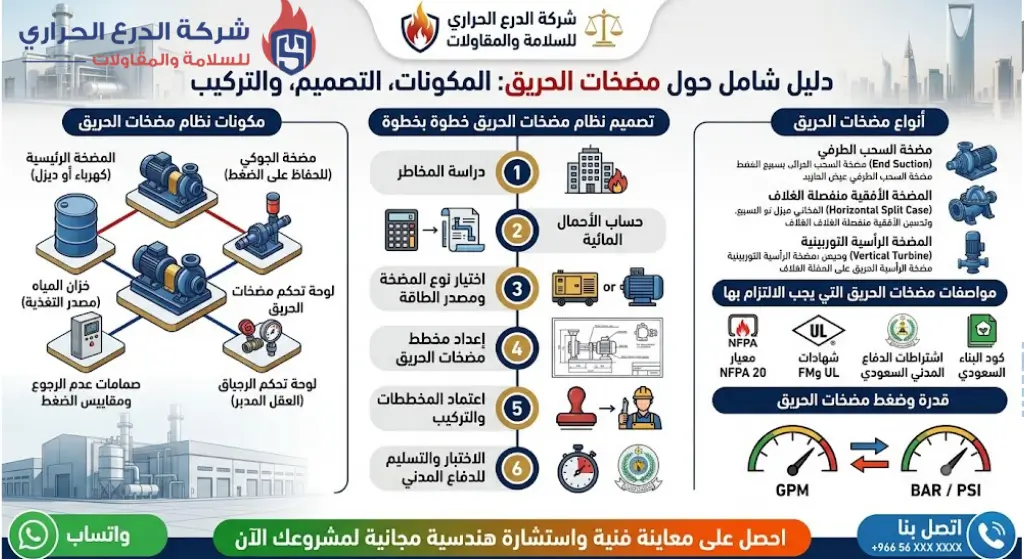
Table of Contents
- What Are Fire Pumps and How Do They Work?
- Fire Pump System Components
- Types of Fire Pumps
- Mandatory Fire Pump Specifications
- Fire Pump Power and Capacity
- Fire Pump Pressure and Units of Measurement
- How to Choose the Right Fire Pump
- Calculating Fire Pump Size
- Calculating Fire Pump Pressure
- Designing a Fire Pump System Step by Step
- Common Mistakes When Dealing with Fire Pumps
- Why Choose Thermoshield for Your Fire Pump Project?
- Frequently Asked Questions About Fire Pumps
- Conclusion
📞 Call Us |
What Are Fire Pumps and How Do They Work?
A fire pump is a mechanical unit designed to draw water from a supply source—such as an underground storage tank, a well, or a public water main—and discharge it at high pressure through the fire piping network to feed automatic sprinklers, fire hose cabinets, and external fire department connections.
The operating mechanism is straightforward in principle: system pressure remains static under normal conditions via a small auxiliary jockey pump. When a fire breaks out and a sprinkler head or fire valve opens, network pressure drops significantly. A pressure switch immediately sends an automatic start signal to the main unit among the fire pumps to discharge required flow and pressure to extinguish the fire before it spreads.
Fire Pump System Components
Understanding components within fire pumps systems is essential before discussing design or selection, as each component performs an indispensable function:
The Main Pump
The backbone of the system, driven either by an electric motor or a diesel engine based on facility criticality and power reliability. Sensitive facilities such as hospitals and major plants prefer diesel units as an independent backup source off the electric grid, ensuring continuous fire pumps operation during power outages.
The Jockey Pump
A low-capacity auxiliary pump designed to compensate for minor system leaks and maintain steady static pressure, preventing the primary unit among fire pumps from triggering for minor pressure fluctuations.
Fire Pump Water Tank
Serves as the primary water supply. Tank volume is calculated based on required duration (typically 30 to 90 minutes according to hazard classification) multiplied by required flow rate in GPM or m³/h. Tanks must be built from corrosion-resistant materials and equipped with level monitoring and periodic cleaning accesses.
Fire Pump Control Panel
The brain of the system, constantly monitoring network pressure, issuing automatic start/stop commands, recording fault events, and signaling low diesel fuel or start failure. Safety codes require control panels for fire pumps to feature clear visual and audible indicators and interface with central Building Management Systems (BMS).
Secondary Components
- Check Valves to prevent backflow.
- Pressure Gauges on suction and discharge lines.
- Test lines and periodic drain valves.
- Flow Meters for periodic performance verification.
Types of Fire Pumps
Different configurations of fire pumps suit various installation, power, and water source requirements:
- End Suction Pumps: Suitable for medium-sized commercial projects; relatively easy to maintain.
- Horizontal Split Case Pumps: Used in large-scale projects requiring high flow rates, featuring high efficiency and operational stability.
- Vertical Turbine Pumps: Used when water supplies originate from wells or low-level static tanks below suction line levels.
- Diesel Driven Pumps: Operate as independent power units, mandatory across critical industrial facilities.
- Jockey Pumps: Maintain static line pressure without triggering primary units.
Mandatory Fire Pump Specifications
Specifications for fire pumps are governed by international and local technical standards rather than contractor preference, including:
- NFPA 20 standard for the installation of stationary pumps for fire protection.
- UL Listed and FM Approved certifications for pump and driver assemblies.
- Saudi Civil Defense requirements and SASO / SABER standards.
- Saudi Building Code (SBC) fire protection provisions.
Adhering to these specifications when sizing fire pumps ensures smooth Civil Defense approval and shields site owners from subsequent legal liabilities in case of an accident.
Fire Pump Power and Capacity
Capacity for fire pumps is measured in Gallons Per Minute (GPM) or cubic meters per hour (m³/h). Typical commercial capacities range from 500 to 2000 GPM, while major industrial facilities and refineries demand significantly higher rates.
When evaluating capacity, engineers analyze the Performance Curve linking flow and head pressure across key operating points:
- At 0% Flow (Shut-off): Pressure must not exceed 140% of rated pressure.
- At 100% Flow: Pump must deliver 100% of rated pressure.
- At 150% Flow: Pressure must not drop below 65% of rated pressure.
This performance curve provides the baseline for engineering approval of fire pumps capacity across projects.
Fire Pump Pressure and Units of Measurement
Pressure for fire pumps is measured in Bar or Pounds per Square Inch (PSI), calculated from combined factors:
- Elevation head to the highest outlet (static loss).
- Friction loss through pipes, fittings, and valves.
- Required operating pressure at the most hydraulically remote sprinkler.
- Safety margin for potential future design modifications.
Distinguishing Suction Pressure from Discharge Pressure yields Rated Pressure (the net pressure boost supplied by the pump), underpinning all calculations for fire pumps.
📞 Call Us |
How to Choose the Right Fire Pump
Selecting proper equipment involves analyzing combined parameters:
- Facility hazard classification (Light, Ordinary, or High Hazard), determining water application density.
- Floor area of the largest single design fire zone.
- Building height and story count, determining static head loss.
- Water supply source (underground tank, well, or municipal main).
- Power grid reliability, determining diesel driver necessity.
- Civil Defense requirements governing the facility activity.
Overlooking these criteria risks installing an oversized system that wastes capital or an undersized unit that fails during emergency operations.
Calculating Fire Pump Size
Sizing starts by establishing design density (GPM/sq.ft) according to hazard class, multiplied by the design area (sq.ft). The product yields total sprinkler flow demand in GPM, forming the foundation for sizing fire pumps.
Adding hose stream allowance (GPM) yields total required capacity, establishing the final nominal flow rate requested from manufacturers.
Calculating Fire Pump Pressure
Calculating total dynamic head involves summing key pressure demands:
- Required end-head pressure at the most remote sprinkler (minimum 0.5 Bar per NFPA).
- Static elevation loss between pump discharge and highest outlet.
- Friction loss calculated via the Hazen-Williams formula across pipe runs.
- Equivalent length losses through valves and fittings.
The sum determines rated pump discharge pressure, presented in official hydraulic calculations submitted to Civil Defense.
Designing a Fire Pump System Step by Step
Designing fire pumps systems follows a structured engineering workflow:
- Hazard Assessment: Defining building occupancy, usage, and risk class.
- Hydraulic Demand Calculations: Determining flow and pressure parameters.
- Water Supply & Tank Sizing: Calculating volume based on operating duration.
- Selecting Driver Type: Electric, diesel, or dual redundant configuration.
- Engineering Drawings: Preparing detailed shop drawings for fire pumps rooms, piping layouts, valves, and test headers.
- Authority Submissions: Obtaining plan approval from Civil Defense.
- Installation & Hydrostatic Testing: Verifying piping integrity under pressure.
- Civil Defense Handover after successful operational testing.
Each design step links directly to the next; errors in initial calculations compromise shop drawing accuracy and overall project compliance.
Common Mistakes When Dealing with Fire Pumps
- Relying on rough estimates rather than precise hydraulic calculations for sizing.
- Neglecting periodic maintenance on jockey pumps under the assumption that they are non-critical.
- Installing control panels without integrating them into the central BMS/FACP.
- Skipping weekly no-flow test runs recommended for diesel engines.
- Undersizing water tanks to reduce initial capital expenditure.
Why Choose Thermoshield for Your Fire Pump Project?
Headquartered in Jeddah, Thermoshield Safety and Contracting combines specialized fire protection engineering with skilled installation teams, delivering complete solutions for fire pumps projects:
- Detailed hydraulic modeling prior to equipment selection.
- Supplying UL Listed / FM Approved equipment compliant with Saudi Civil Defense regulations.
- Constructing pump rooms and water tanks to engineering standards.
- Programming control panels and testing automatic operation scenarios.
- Providing annual maintenance contracts ensuring year-round readiness.
- Proven track record across industrial and commercial sites in Jeddah and surrounding regions.
Frequently Asked Questions About Fire Pumps
What is the difference between electric and diesel fire pumps?
Electric pumps feature lower installation and maintenance costs but require emergency generator backup during power cuts. Diesel pumps operate independently of grid power, making them mandatory in critical facilities requiring independent power sources.
How often should fire pumps be tested?
Weekly no-flow test runs (30 minutes for diesel, 10 minutes for electric) are recommended, alongside annual full-flow testing to verify actual output against the original performance curve.
Can a single fire pump set serve a mixed-use building?
Yes, provided hydraulic calculations confirm one system can satisfy the highest demand zone with adequate safety margins. If hazard levels vary drastically across sections, separate zones or custom pump configurations may be required.
Which authority approves fire pump engineering drawings in Saudi Arabia?
Engineering drawings are reviewed and approved by Saudi Civil Defense, requiring preparation by a licensed engineering office compliant with local and international codes.
What is the standard water supply operating duration for fire pump tanks?
Durations typically range from 30 to 90 minutes depending on occupancy hazard class, with longer durations mandated for high-hazard industrial risks as determined by engineering studies.
📞 Call Us |
Conclusion
Every step in implementing fire pumps demands precise engineering and strict code compliance. Thermoshield Safety and Contracting stands ready to guide your project from initial calculations to final Civil Defense handover, backed by teams understanding regulatory standards.
Need technical studies, supply, or installation of approved fire pumps for your site?
Contact Thermoshield today by phone at +966564821140, email info@thermoshield.sa, or via our contact page to request a free engineering consultation and start your project on the right foundation.