

Every facility that receives workers, visitors, or vehicles requires a clear safety signs system to guide individuals during emergencies and warn them of hazard sources before incidents occur. The absence of these signs or placing them in incorrect locations means that the facility may fail the Civil Defense inspection, and workers will not know the evacuation route when a fire or any other emergency breaks out.
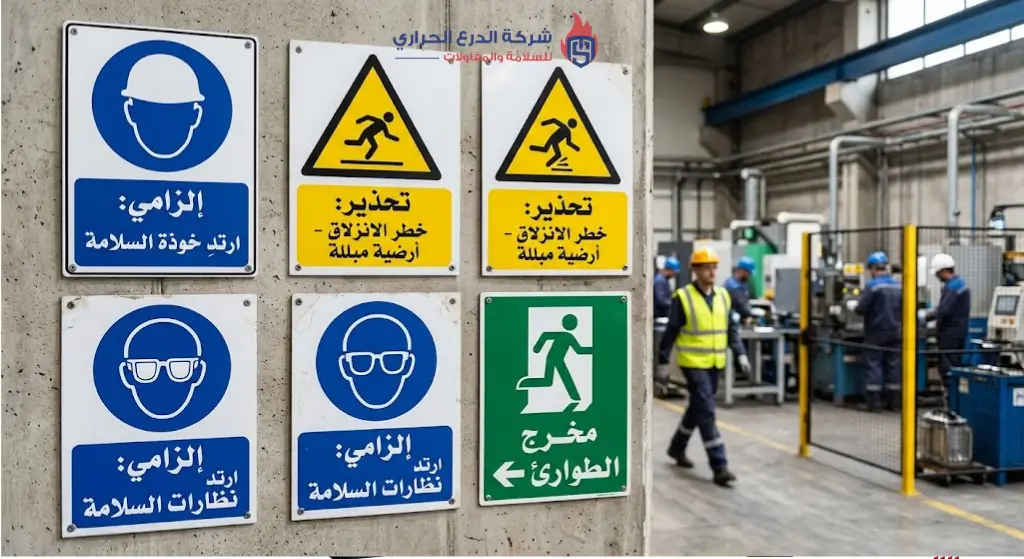
Table of Contents
- What are Safety Signs?
- Why Does a Facility Need Safety Signs?
- What are the Types and Colors of Safety Signs?
- Where are Safety Signs Placed Inside the Facility?
- How Do Safety Signs Relate to Civil Defense Requirements?
- What is the Difference Between Safety Signs and a Safety Plan?
- What are the Common Mistakes in Using Safety Signs?
- When Does a Facility Need to Review Its Safety Signs?
- What Services Does Thermoshield Offer Regarding Safety Signs?
- Frequently Asked Questions About Safety Signs
- Conclusion
📞 Call Us |
What are Safety Signs?
Safety signs are visual signboards placed inside commercial, industrial, and construction facilities to guide individuals toward emergency exits, warn them of surrounding hazards, and specify mandatory safety procedures such as wearing Personal Protective Equipment (PPE).
These signs rely on standardized colors and symbols that are easily understood visually without the need to read extensive text, making them effective in situations where a person needs to make a quick decision.
Globally, safety signs are classified under the ISO 7010 standard, which defines the uniform shapes, colors, and symbols for occupational health and safety signs. This is the primary reference relied upon by most signage systems used in Saudi facilities, alongside local Civil Defense regulations.
Why Does a Facility Need Safety Signs?
The presence of safety signs is not a formal procedural step, but an essential part of the life protection system inside any building or work environment. Their significance is highlighted in three main points:
- Guiding Evacuation During Emergencies: Signs point out the nearest emergency exit and safe assembly point without hesitation or panic.
- Warning Workers of Hazard Sources: Such as high-voltage electrical zones, flammable materials, or work-at-height areas.
- Supporting Compliance with Civil Defense Requirements: Obtaining a safety license strictly mandates providing clear directional safety signs for emergency exits as part of the facility’s minimum statutory equipment to meet Civil Defense requirements.
What are the Types and Colors of Safety Signs?
Safety signs are divided into main categories according to their function, with each category having a distinctive color to facilitate instant recognition from a distance:
Warning Signs
Yellow background with a black symbol, used to indicate hazards such as slipping, falling, chemical exposure, or high electrical voltage.
Prohibition Signs
White background with a red circular border and diagonal slash, indicating prohibited actions such as no smoking or no unauthorized entry.
Mandatory Signs
Blue background with a white symbol, indicating mandatory safety protocols such as wearing safety helmets, protective goggles, or safety harnesses.
Emergency and Evacuation Signs
Green background with a white symbol, indicating escape routes, emergency exits, safe assembly points, and first-aid stations.
Firefighting Equipment Signs
Red background, pointing out the exact locations of fire extinguishers, fire hose cabinets, fire pumps, and manual call points.
This color-coding system is not arbitrary; it enables instant comprehension even for individuals who cannot read or do not speak the language written on the signage.
Where are Safety Signs Placed Inside the Facility?
Determining the proper location of a sign is just as critical as selecting its correct type. A sign installed in an improper spot may fail its intended purpose even if manufactured to exact specifications. When planning safety signs distribution, the following rules apply:
- Positioning evacuation signs at every corridor intersection and staircase entrance to ensure continuous direction toward the exit.
- Mounting firefighting signs directly above or immediately adjacent to firefighting equipment, never far from them.
- Placing warning signs sufficiently ahead of entering a hazard zone to give personnel enough time to react.
- Selecting a standardized installation height that guarantees visibility from various viewing angles without physical obstructions.
- Considering ambient lighting conditions, as certain safety signs require photoluminescent (glow-in-the-dark) properties during sudden power outages.
📞 Call Us |
How Do Safety Signs Relate to Civil Defense Requirements?
Providing directional signs leading to emergency exits represents one of the minimum mandatory requirements checked by Civil Defense when issuing or renewing a facility’s safety permit. On-site field inspections audit the efficiency and distribution of all safety equipment across the premises, including warning and directional safety signs, fire extinguishers, and early alarm systems.
In practice, any deficiency or ambiguity in these signboards may delay permit issuance or mandate a correction period before a reinspection is carried out. Therefore, the design of a safety signs layout should never be executed randomly, but within an integrated safety plan accounting for all internal movement flow.
What is the Difference Between Safety Signs and a Safety Plan?
Many facility owners confuse the two concepts. Safety signs are the physical visual elements mounted on walls and corridors, whereas a safety plan is the comprehensive engineering blueprint that specifies the locations of these signs, evacuation routes, firefighting hardware, and safe assembly zones before physical execution.
In other words, the safety plan is the engineering framework upon which the logical and compliant distribution of safety signs is carried out across the building.
What are the Common Mistakes in Using Safety Signs?
Some facilities install safety signs without prior engineering studies, leading to frequent operational errors such as:
- Repeating one sign type in a single area while omitting other mandatory signage.
- Using single-language signs in facilities employing a multilingual workforce.
- Mounting signs behind equipment or furnishings that obstruct direct line of sight.
- Failing to update safety signs following modifications to internal passageways or building expansions.
- Relying on substandard signs that do not adhere to approved ISO colors and symbols, complicating emergency recognition.
When Does a Facility Need to Review Its Safety Signs?
Specific triggers mandate a comprehensive review of the entire signage layout, including building extensions, adding new floors, reclassifying space from office to industrial usage (or vice versa), approaching safety permit renewal deadlines, or receiving remarks from Civil Defense inspectors.
In these cases, updating the safety plan before redistributing safety signs prevents repeating placement errors.
What Services Does Thermoshield Offer Regarding Safety Signs?
Thermoshield Safety and Contracting Company provides comprehensive evacuation planning and safety equipment services as part of its fire alarm and suppression portfolio. This includes mapping escape routes and determining optimal safety signs placements tailored to each facility’s operational profile, alongside designing engineered industrial security and safety plans that define all safety elements prior to execution.
Furthermore, the company delivers technical safety reports and engineering certificates for Civil Defense submissions, as well as risk assessment studies that prioritize sign installation based on hazard classifications across different facility zones.
Frequently Asked Questions
What is the difference between a warning sign and a prohibition sign?
A warning sign has a yellow background and highlights a potential hazard to be cautious of, whereas a prohibition sign features a white background with a red border indicating an action strictly forbidden in that area.
Does Civil Defense mandate safety signs in all facilities?
Yes, installing directional safety signs for emergency exits is a mandatory baseline requirement verified by Civil Defense during safety permit issuance procedures, regardless of the business activity.
Can safety signs be installed without an engineering safety plan?
Practically, this is not recommended. Installing signs without a blueprint often leaves blind spots or causes unnecessary duplication, whereas a safety plan guarantees comprehensive and code-compliant coverage for all circulation routes.
How often should safety signs be reviewed within a facility?
Safety signs should be audited whenever layout or operational changes occur, as well as periodically prior to safety permit renewals to verify alignment with actual site conditions.
Who determines the mounting location of each sign inside a building?
Locations are determined during the safety plan preparation phase by fire protection engineers based on egress calculations, firefighting hardware placement, and hazard ratings across each department.
📞 Call Us |
Conclusion
Safety signs are not decorative additions, but a vital part of an integrated protection system that begins with an engineered safety plan and concludes with compliant sign positioning covering every pathway inside the facility.
If your facility needs to review or design a comprehensive safety plan and directional signage layout, you can reach out to Thermoshield Safety and Contracting Company to submit your site details and receive full technical guidance prior to installation.