
Mandatory engineering requirements issued by regulatory authorities dictate that supply and installation of safety equipment represent the foundational pillar for protecting lives and facilities from fire hazards and operational infrastructure collapses. Fire suppression and early warning systems demand precise engineering alignment starting from hydraulic design down to linking networks with accredited platforms. Thermoshield Company strives to provide these provisions at highest quality specifications to ensure industrial, commercial, and residential facility readiness for immediate response during emergencies while fully complying with regulatory parameters.
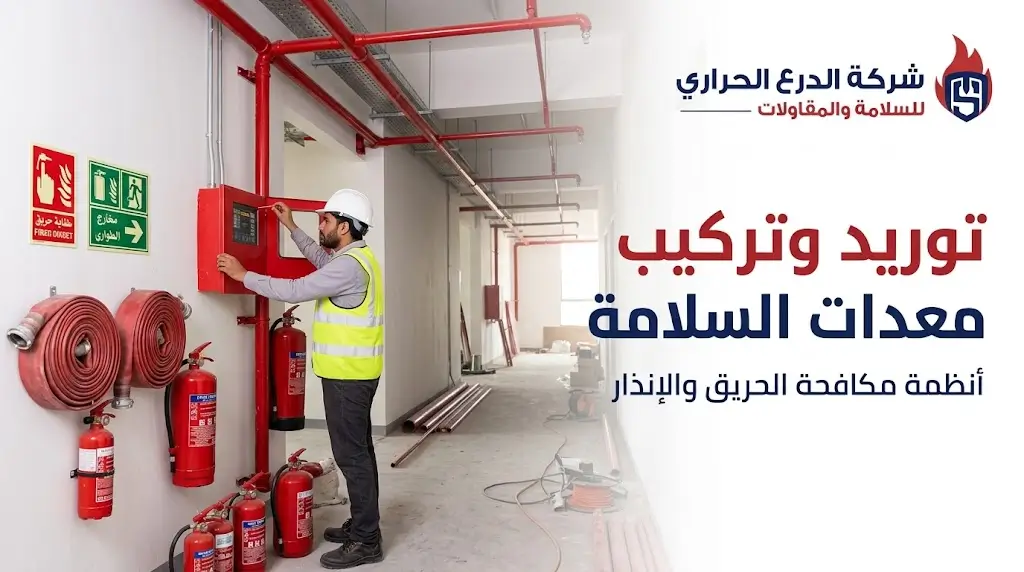
Table of Contents
- Summary of Engineering Standards for Protection Systems
- Importance of Supply and Installation of Safety Equipment for Facilities and Buildings
- Supply and Installation of Safety Means, Systems, and Firefighting
- Civil Defense and Platform-Accredited Safety Equipment
- Fire Extinguisher Supply, Maintenance, and Accredited Fire Pumps
- Automatic Suppression Networks, Hose Cabinets, and Gas Systems
- Control Panels, Smoke Detectors, Emergency Doors, and Lighting
- Personal Protective Equipment, Security Devices, and Low Voltage Systems
- Compliance with Saudi Building Code and Quality Standards
- Electronic Technical Reports and Site Handover to Authorities
- Geographical Distribution: Riyadh, Jeddah, Dammam, and Makkah
- Periodic Maintenance Contracts and Field Inspections
- Frequently Asked Questions
Call Us |
Summary of Engineering Standards for Protection Systems
Supply and technical standards for protection systems rely on matching materials to standard specifications and testing them through network pressure testing and alarm circuit monitoring. These procedures ensure the facility remains operationally ready:
- Design Compliance: Linking distribution layouts with water density calculations and gaseous suppression medium flow rates.
- Readiness Inspection: Executing hydrostatic pressure tests for pipes equivalent to 200 psi for two hours without drop.
- Electronic Accreditation: Registering all provisions and issuing test reports via officially approved digital platforms in the Kingdom.
Importance of Supply and Installation of Safety Equipment for Facilities and Buildings
Approved engineering operations for supply and installation of safety equipment guarantee halting fire propagation in initial stages, minimizing material and human losses, and enabling emergency teams to handle incidents rapidly by providing integrated supply lines protected from direct thermal damage. The importance of regulatory installations transcends mere paperwork fulfillment; lacking heat-resistant provisions or using valves and pipes non-compliant with operating pressures leads to firefighting line explosions or early warning failures, elevating structural collapse risks under thermal stress. These systems integrate engineered evacuation paths for occupants by controlling smoke movement and securing egress path illumination, granting facility occupants adequate time for organized exit before toxic gases reach asphyxiation levels. Furthermore, these documented procedures protect facility investments from regulatory fines and administrative delays resulting from non-compliance with official licensing requirements.
Supply and Installation of Safety Means, Systems, and Firefighting
Integrated mechanical and electrical firefighting solutions rely on studying radiative loads and occupancy nature classifications within facilities to guarantee valve response, suppression medium distributors, and smoke sensor triggers within specific timeframes for each hazard category. Components of the integrated system include high-pressure-resistant black seamless steel pipe networks, alongside butterfly valves equipped with electrical open/close position monitoring switches to prevent sudden water stoppage. Water suppression systems integrate with early warning detection networks transmitting signals to central monitoring rooms, enabling booster pump activation and automated isolation of HVAC and mechanical ventilation systems to restrict oxygen flow toward combustion zones and prevent toxic gas transfer between fire-isolated floors.
Call Us |
Civil Defense and Platform-Accredited Safety Equipment
All used equipment and materials are subject to binding technical specifications ensuring every product is registered through digital accreditation portals, confirming receipt of certificates of conformity issued by recognized quality and product testing laboratories inside and outside the Kingdom. Regulatory compliance requires submitting certificates of origin and factory testing for each supply batch, verifying compliance of fire pumps, control valves, alarm panels, and pressure relief valves with Salamah platform procedural requirements. Thermoshield oversees reviewing serial numbers of equipment, matching them against approved engineering layouts, and verifying operational seals and resistance to humidity and high temperatures, preventing facility rejection during field inspection visits conducted by inspection committees responsible for issuing operating licenses.
Fire Extinguisher Supply, Maintenance, and Accredited Fire Pumps
Portable and mobile fire extinguishers represent the primary frontline defense for containing limited ignition, while central pumping stations guarantee appropriate hydraulic pressure flows for fire networks distributed across buildings continuously and regularly. Manual extinguishing devices vary among dry chemical powder extinguishers multi-purpose for solids and flammable liquids, carbon dioxide devices directed at sensitive electrical panels and circuits to leave no conductive residue, and foam extinguishing agents for fuel and oil warehouses. Accredited water firefighting pumping stations consist of three main operational units working in automated integration:
- Electric Pump: Acts as primary water supply source immediately upon pressure drop inside the building’s water network.
- Backup Diesel Pump: Automatically engages during power outages or main pump failure to ensure water flow continuity.
- Jockey Pressure Maintenance Pump: A small multi-stage pump maintaining stable static pressure inside pipes and compensating minor leaks without starting major pumps.
| Equipment Type | Engineering Use | Standard Capacity | Suppression Medium | Operational Inspection Standard |
|---|---|---|---|---|
| Dry Powder Extinguisher | General facilities & offices | 6 to 12 kg | Monoammonium phosphate | Pressure gauge check & hose integrity |
| CO2 Extinguisher | Electrical & server rooms | 2 to 10 kg | High-pressure liquefied gas | Weight measurement & safety valve verification |
| Foam Extinguisher | Fuel & oil warehouses | 9 to 50 liters | Aqueous film-forming foam | Antifreeze check & air-mixing nozzle test |
| Electric Fire Pump | Sprinkler & hose feeding | 500 to 2000 GPM | High-pressure water | Flow rate & churn pressure test |
| Diesel Fire Pump | Emergency during power failure | Matches main pump capacity | Pure hydraulic water | Weekly run & cooling circuit check |
Automatic Suppression Networks, Hose Cabinets, and Gas Systems
Automatic water suppression networks depend on heat-sensitive sprinkler heads whose glass bulbs break at specific temperatures to release water vertically, while hose cabinets provide immediate support for manual intervention teams. Sprinkler heads are distributed per precise engineering patterns considering permitted spacing and structural obstructions like beams, girders, and ductwork, utilizing thermal bulb classifications ranging from 68°C for offices up to higher grades inside kitchens and boiler rooms. 1-inch fire hose cabinets are used by regular occupants with semi-rigid rubber hoses, whereas 2.5-inch hose connections are allocated for Civil Defense teams delivering high-pressure water flows. In areas where water causes catastrophic damage to technical or historical assets, alternative systems are utilized:
- Clean Agent Gas Systems: Utilizing approved gases stored under nitrogen pressure and discharged within ten seconds to reduce oxygen concentration and extinguish flames without harming servers and electronics.
- Total Flooding Carbon Dioxide Systems: Installed inside massive electrical transformer and generator rooms to completely isolate the space with a flame-suffocating gas.
- Kitchen Fire Suppression Systems: Wet chemical systems relying on potassium compounds to spray hoods and cooking surfaces, reacting with hot greases and converting them into a soap-like substance preventing re-ignition.
Control Panels, Smoke Detectors, Emergency Doors, and Lighting
Early warning infrastructure consists of advanced control panels receiving signals from distributed sensors and dispatching operational commands to audio-visual alert devices, integrating with doors and emergency pathways to facilitate building evacuation. Control and alarm panels divide into two main types:
- Conventional Systems: Dividing the building into specific geographical zones containing groups of sensors, used in small and medium projects where visual inspection of zones is straightforward.
- Analog Addressable Systems: Assigning each detector an independent programmatic address displayed on panel screens indicating exact floor and room numbers, expediting fire localization in towers, hospitals, and large complexes.
Photoelectric smoke detectors sense fine particles during initial combustion stages, whereas thermal detectors in warehouses and kitchens prevent false alarms from steam and dust. Panels link with sounder sirens and strobe units, triggering synchronous alarms alongside voice evacuation units programmed to direct occupants toward emergency exits. Protection is completed by installing fire-resistant emergency doors with fire-resistance ratings from 1 to 3 hours, equipped with push-bar panic hardware and self-closing mechanisms, supported by self-charging emergency lighting units operating on internal batteries to illuminate escape paths and stairwells during grid failures.
Personal Protective Equipment, Security Devices, and Low Voltage Systems
Field safety systems integrate worker personal protection using protective gear with building digital monitoring and low-voltage equipment to achieve complete field control during routine and emergency conditions. Worker PPE includes impact-resistant hard hats, radiation and splash-resistant goggles, dust and organic gas masks, heat and tear-resistant work suits, steel-toe safety boots, and triple-action lanyards with anchorage points for fall protection during high-elevation work. Facilities are also equipped with supplementary devices:
- First Aid Kits & Cabinets: Mounted in visible locations containing burn dressings, wound care supplies, splints, and resuscitation masks.
- Thermal and Digital Surveillance Cameras: Monitoring hazardous points and warehouses to detect thermal rises before ignition develops.
- Access Control Systems: Programmed to automatically unlock all emergency gates and protected exits upon alarm activation to prevent trapping people inside buildings.
Compliance with Saudi Building Code and Quality Standards
Saudi Building Code clauses dictate design, supervision, and safety material supply requirements per general and mechanical fire protection codes, mandating rigorous testing for all provisions to prove compliance with certified quality standards. The code specifies area ratios, fire compartment dimensions, exit travel distances, and non-combustible insulation materials, prohibiting exterior cladding or insulation unless certified to prove non-contributory flame spread. Thermoshield supervises structural calculations for pipes and seismic bracing preventing vibration and cracking of firefighting networks during earthquakes or hydraulic pressure fluctuations, conducting periodic sample tests and documenting valve and sprinkler performance to guarantee absolute compatibility with the Saudi Building Code and Kingdom safety requirements.
Electronic Technical Reports and Site Handover to Authorities
Project completion and operational licensing procedures require preparing integrated engineering documentation files uploaded through official electronic portals, including field measurement results and As-Built drawings for fire protection networks. Electronic technical reports are prepared through the following procedural steps:
- Field Layout Verification: Inspecting locations of firefighting units, alarms, and hose cabinets to ensure complete conformity with previously approved design layouts.
- Water Pressure Flow Tests: Executing hydraulic flow testing for pumps and sprinkler heads, recording pressure gauge readings and air purging.
- Early Warning Interconnection Check: Simulating smoke detection at furthest points and verifying main panel response, siren activation, HVAC isolation, and smoke extraction fan operation.
- Report Submission & Authentication: Entering technical data, material test certificates, and installation photos via electronic platforms, signed by certified engineers to handover sites and facilitate Civil Defense license issuance.
Geographical Distribution: Riyadh, Jeddah, Dammam, and Makkah
Infrastructure and commercial facility projects across major cities demand solutions respecting specific climatic conditions to ensure continuous field equipment efficiency. Thermoshield provides supply and installation of safety equipment matching diverse environmental conditions in Riyadh, Jeddah, and Dammam. Riyadh projects face dry, high temperatures requiring valves and pumps capable of withstanding extreme operational heat alongside shading and cooling provisions for external pump stations. Coastal projects in Jeddah and Dammam dictate treated pipes resistant to salinity, humidity, and corrosion, alongside dust and sea-spray insulated alarm panels and firefighting cabinets to guarantee operation sustainability and prevent electrical connection erosion. In Makkah, characterized by exceptional human density and continuous hotel/commercial activity, executing safety equipment supply and installation per engineering plans accommodating major expansions and rapid evacuation requirements for pilgrims is vital. This includes smart fire detectors highly immune to false alarms from water vapor, coupled with long-fire-resistant doors supported by positive air pressure stairwell pressurization systems to isolate smoke completely, alongside fast suppression systems for central kitchens and transport hubs complying with central area and holy sites regulations.
Periodic Maintenance Contracts and Field Inspections
Regulations governing buildings and facilities mandate establishing documented periodic inspection and maintenance agreements ensuring continuous network effectiveness, particularly upon completing safety equipment supply and installation projects and field accreditation. These accredited contracts include quarterly and monthly inspection periods measuring alarm panel battery torque, testing diesel generator and fire pump operation, monitoring hydraulic pressure balance in sprinkler lines, and inspecting chemical suppression media in portable extinguishers and clean agent systems. These visits are periodically logged, uploading maintenance reports on digital platforms to ensure facility operating licenses remain active without interruption, preventing activity suspension or technical fines. Initial engineering site surveys before execution analyze latent risks, determine required equipment, and calculate fire loads, serving as a critical preliminary step before safety supply and installation projects commence.
Call Us |
Frequently Asked Questions
How is the compliance of supplied fire extinguishers with specifications verified?
Verification includes checking the technical data sheet, manufacturing registration number, production and filling date, official quality marks, pressure gauge alignment with the green zone, and safety pin/hose integrity.
What is the difference between wet and dry pipe firefighting networks?
Wet pipe networks are permanently filled with water under constant pressure, discharging immediately upon sprinkler bulb breakage, whereas dry pipes are filled with compressed air or nitrogen for freezing-prone or leak-sensitive areas, with water entering only after the main valve automatically opens.
What standards govern the placement distances of emergency exit doors?
The maximum travel distance to reach an emergency exit depends on occupancy type and sprinkler coverage, typically ranging from 30 meters in non-sprinklered buildings up to 75 meters in sprinkler-protected facilities per the Saudi Building Code.
Does the Saudi Building Code require clean agent gas systems in all buildings?
No, they are not required across all building parts; installation is restricted to sensitive rooms vulnerable to water damage such as generator and transformer rooms, server data centers, and critical archives.
How often should diesel fire pumps be test-run to ensure reliability?
It is recommended to run diesel pumps weekly for 30 minutes to monitor oil pressure, coolant temperature, battery charging, and fuel supply circuit integrity, ensuring automatic response during power failures.
How does Thermoshield assist in successfully passing Civil Defense inspections?
The company inspects all field equipment, executes compatibility tests, issues officially accredited engineering compliance reports, and resolves any field remarks prior to the Civil Defense inspection visit to guarantee facility accreditation.
Protecting your investments and facilities requires adopting advanced safety systems compliant with official engineering parameters. Thermoshield’s engineering team delivers comprehensive expertise spanning design stages and hydraulic calculations, providing all firefighting equipment, pumping stations, and accredited early warning networks, alongside drawing preparation and electronic technical report submission via official platforms for licensing issuance and renewal without delay. You can contact Thermoshield directly to request site surveys, study actual project needs, and execute your integrated safety system (thermoshield.sa).