
Protecting lives and vital assets in modern facilities requires rigorous engineering compliance and precise implementation of prevention networks; here lies the pivotal role provided by an accredited security and safety contracting company to ensure a secure work environment compliant with international standards.
📞 Call Us |
Importance of Choosing an Accredited Safety Contracting Company for Buildings
Contracting with a specialized organization ensures the implementation of engineering schematics with high hydraulic and electrical precision, mitigating operational vulnerabilities that could jeopardize the facility and safeguarding official approvals.
Administrative, residential, and commercial properties demand integrated protection networks that harmonize seamlessly with structural frameworks. Engaging an accredited safety contracting firm delivers a comprehensive engineering solution to real estate developers, encompassing hazard vulnerability assessments, compliant material procurement, and rigorous hydrostatic pressure testing prior to final handover to regulatory authorities.
Installation and Maintenance of Fire Alarm Systems & Smoke Detectors
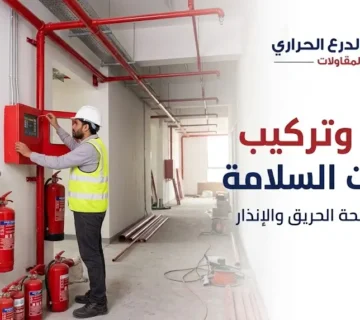
Early detection systems rely on advanced networks of optical and thermal smoke detectors connected directly to centralized control panels that trigger instantaneous alerts upon identifying anomalous environmental conditions.
Execution procedures entail deploying fire-rated cabling, calibrating sensors according to engineering-approved coverage areas, and integrating notification horns, strobes, and manual pull stations to facilitate rapid, organized, and panic-free occupant evacuation.
Fire Suppression Networks, Automatic Sprinklers & Fire Hose Systems
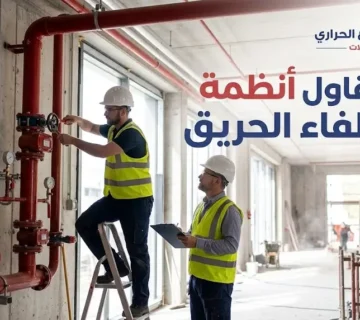
Water-based fire suppression infrastructures utilize heavy-duty steel piping engineered to withstand extreme pressures. Automatic sprinkler heads are positioned strategically based on hydraulic design densities to discharge promptly upon reaching activation temperature thresholds.
These networks interface with fire hose cabinets equipped with fast-deployment reels and primary control valves, establishing an immediate frontline firefighting capability readily accessible to trained emergency personnel before structural hazards escalate.
📞 Call Us |
Dual and Triple Fire Pumps: Inspection and Testing
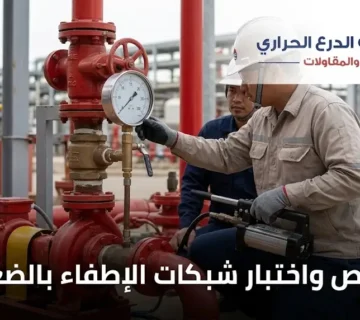
Fire pump assemblies constitute the lifeblood of water-based extinguishing systems. Configurations typically comprise a primary electric-driven pump, a secondary standby diesel-driven pump, and an auxiliary jockey pump for systematic pressure maintenance, all subjected to scheduled diagnostic inspections.
These sets undergo rigorous hydraulic flow tests and discharge pressure validations to certify sufficient flow and head capacity reaching the most remote and highest hydraulic nodes within the building, verified through approved project engineering calculations.
Civil Defense Requirements for Facility and Building Safety
The General Directorate of Civil Defense mandates stringent technical regulations encompassing compliant escape corridors, emergency lighting coverage, and hazard-classified suppression hardware distributions designed to compartmentalize fire risks and facilitate emergency response access.
Full compliance with these technical benchmarks guarantees swift issuance of official operational and building permits while averting legal citations through engineered, accredited life-safety installations.
Control Panels, Evacuation, and Facility Emergency Engineering
System-wide detection and evacuation networks are orchestrated by intelligent addressable or conventional fire alarm control panels (FACPs) pinpointing the exact spatial coordinates of thermal events or supervisory trouble faults.
These panels integrate directly with public address/voice evacuation systems and electromagnetic emergency door releases, ensuring automated door unlatching during utility outages or alarm activation to preserve life safety.
Surveillance Cameras and Electromechanical Safety Integration
Advanced security frameworks incorporate high-resolution CCTV networks linked to command hubs, alongside integrated electromechanical (MEP) controls to orchestrate synchronized emergency procedures.
This integration empowers rapid visual verification of operational hazards, while triggering automated HVAC shutdown, pressurizing stairwells via smoke extraction and ventilation systems, and executing primary elevator ground recall sequences during emergencies.
Compliance with NFPA Standards for Fire Pumps
Advanced engineering designs align strictly with National Fire Protection Association (NFPA) criteria—notably NFPA 20—to enforce supreme operational reliability in sizing, selecting, and commissioning fire pump packages.
This compliance governs pipe diameters, sizing criteria, clearance envelopes, pressure-relief valves, and dedicated water storage reserves, fulfilling recognized global engineering specifications for mission-critical properties.
Safety Systems for Warehouses, Industrial Plants, and Commercial Facilities
Storage warehouses and manufacturing plants necessitate custom suppression solutions utilizing foam concentrations or clean agent gaseous fire suppression systems suited to combustible commodity classes and chemical fuel loads.
Each industrial profile is evaluated separately to calculate fire load densities, determining tailored suppression media to neutralize thermal events while averting collateral damage to sensitive equipment and critical data centers.
The Role of ThermoShield in Installation and Maintenance
ThermoShield executes turnkey fire protection and safety projects adhering to the highest global standards, supported by comprehensive preventive maintenance contracts that ensure maximum system availability year-round.
Certified engineering crews apply diagnostic calibration instruments to verify the readiness of alarm matrices, pressure risers, and pumping assets, fulfilling the operational expectations of investors and property developers.
Comprehensive Engineering Consultations for the Safety Sector
Our engineering teams provide dedicated advisory services for auditing and developing safety plans and engineering drawings for upcoming and existing developments, ensuring complete alignment with official licensing protocols.
These advisory reviews optimize project capital expenditure, prevent costly on-site change orders, and guarantee full code compliance right from preliminary design drafts.
Ensuring Operational Efficiency and Reliability of Firefighting Networks
Hydraulic distribution piping undergoes structured preventive maintenance programs featuring line flushing, non-return check valve inspections, and hydrostatic pressure testing to maintain absolute emergency preparedness.
Systematic preventive upkeep prolongs physical asset lifespans, reduces lifecycle depreciation, and optimizes reliability coefficients, preventing unexpected system outages during critical incidents.
Global Quality Standards and Preventive Risk Management
Major industrial installations enforce international quality standards across hardware procurement and component installation, integrating UL-listed and FM-approved devices to maximize operational integrity.
Formulating dynamic risk management matrices and business continuity frameworks protects client equity against catastrophic disruption, shrinking operational downtime and ensuring business operations can promptly resume post-incident.
Official Regulatory Bodies and Standards
- General Directorate of Civil Defense (Kingdom of Saudi Arabia).
- National Fire Protection Association (NFPA).
- Saudi Building Code – Fire Protection Standards (SBC 801).
Frequently Asked Questions
What is the importance of hiring an accredited safety contracting company?
It guarantees official regulatory approvals and engineered execution aligned with Civil Defense requirements, facilitating immediate licensing while safeguarding occupants and physical assets.
How are fire pumps routinely inspected and tested?
Through scheduled hydraulic performance tests measuring flow rates (GPM) and discharge pressures (PSI) across primary electric, standby diesel, and jockey units to confirm operational capacity.
What are the fundamental components of an automatic fire suppression system?
The system consists of dedicated fire pump packages, carbon steel piping networks, fire hose cabinets, automatic sprinkler heads, and system control and check valves.
Does ThermoShield provide recurring preventive maintenance services?
Yes, ThermoShield delivers comprehensive annual maintenance contracts covering periodic preventive and corrective servicing for alarm panels, pump skids, and suppression networks.
How do engineered systems conform to NFPA codes?
By applying precise hydraulic flow calculations, verified pipe schedules, standardized detector spacing, and NFPA 20-compliant pump installations.
What is the expected timeframe for installing safety and fire systems?
Project duration varies depending on gross floor area, building classification (commercial, industrial, or residential), and engineering review phases established post-drawing approvals.
Conclusion
To safeguard your facility and secure maximum life safety compliance alongside prompt official certifications, reach out to certified engineering consultants at an accredited security and safety contracting company through ThermoShield.
Contact our engineering team today to initiate your project audit and protect your investments to the highest accredited standards.
📞 Call Us |