
When power suddenly cuts out inside a commercial building, factory, or warehouse, darkness is not the only issue; it transforms into an immediate threat endangering the safety of everyone inside. Here, the role of an emergency light emerges as the first line of defense, guaranteeing clear visibility along evacuation routes during the critical initial seconds of a blackout.
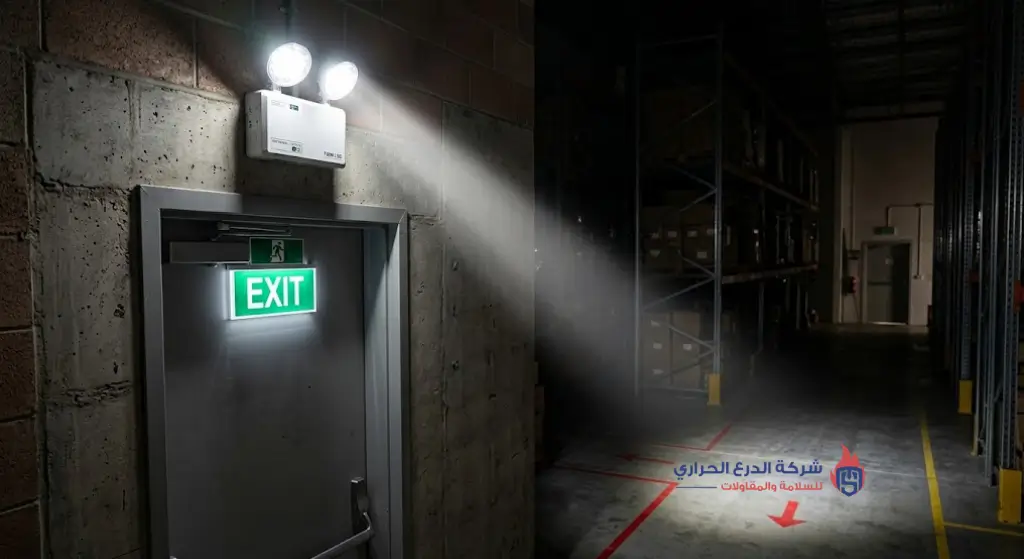
Table of Contents
- Emergency Light
- Why is an Emergency Light Indispensable in Any Facility?
- Regulatory Framework: Is Emergency Light Installation Mandatory?
- Types of Emergency Light Units Used in Facilities
- Technical Specifications Required in an Emergency Light
- Where Should Emergency Light Units Be Installed Inside the Facility?
- Difference Between an Emergency Light and Standard Backup Lamps
- How to Choose the Right Emergency Light for Your Facility?
- Common Mistakes When Installing Emergency Lights
- Periodic Maintenance for Emergency Lights
- The Role of Thermoshield in Supplying and Installing Emergency Lights
- Frequently Asked Questions
- Conclusion
📞 Call Us |
Emergency Light
An emergency light is a self-contained illumination unit powered by an internal rechargeable battery that automatically switches on when the main electrical supply fails. Unlike standard portable torches, this device is designed to remain permanently connected to the main circuit on continuous float charge, automatically engaging high-intensity LED lamps to illuminate exit paths and corridors upon power loss.
In commercial and industrial establishments, an emergency light is not treated as an optional accessory, but rather as an essential legally mandated life safety component governed by Saudi Civil Defense requirements.
Why is an Emergency Light Indispensable in Any Facility?
Many property owners believe that backup standby generators suffice to cover outages; however, this is a misconception for several key reasons:
- Generators require seconds or minutes to start up and synchronize, during which the facility remains pitch black.
- During fire emergencies, mains power may be intentionally isolated for firefighter safety, whereas an emergency light continues functioning independently.
- Stairwells, emergency exits, and narrow passageways require localized, self-contained illumination isolated from centralized grid failure points.
- Certain generators only power critical loads like elevators and medical systems, leaving general lighting circuits unpowered.
For these reasons, an emergency light remains a distinct, irreplaceable life safety necessity.
Regulatory Framework: Is Emergency Light Installation Mandatory?
Yes, Saudi Civil Defense mandates providing emergency lighting along egress paths, main exits, and secondary exits across commercial, industrial, and multi-story residential buildings. An emergency light must operate for a specified backup duration (typically not less than 90 minutes), delivering sufficient lux levels to clearly illuminate exit signage and stairwells.
Failing to provide an operational emergency light constitutes a regulatory violation during routine inspections, which may delay the issuance or renewal of the facility's safety certificate, which directly impacts operational licensing continuity.
Types of Emergency Light Units Used in Facilities
1. Twin Spot Emergency Light
The most common type in commercial and industrial settings, featuring two adjustable directional projector heads that provide broad area coverage across warehouse aisles, intersections, and manufacturing floors.
2. Exit Sign Combo Emergency Light
Combines illumination and directional guidance by integrating an illuminated EXIT sign alongside emergency spotlights, ideal for main entryways and final exit doors where clear visual direction is required alongside lighting.
3. Self-Testing Emergency Light
Equipped with an electronic circuit that conducts automated periodic battery and lamp diagnostics, alerting maintenance teams to faults without requiring constant manual inspection, preferred for large facilities with high unit counts.
4. Weatherproof & Dustproof Emergency Light (IP65)
Engineered for outdoor locations or harsh industrial environments subject to high humidity and dust ingress, such as semi-open warehouses or production lines adjacent to water or steam sources.
📞 Call Us |
Technical Specifications Required in an Emergency Light
Selecting an emergency light must not rely solely on price; critical technical specifications determine real-world effectiveness:
- Backup Duration: Minimum 90 minutes of continuous operation following main power failure, in accordance with life safety codes.
- Response Time: Immediate activation within seconds of grid disconnection without noticeable delay.
- Battery Chemistry: Long-life Nickel-Cadmium or Lithium-Ion cells resilient against high ambient operating temperatures.
- Ingress Protection (IP Rating): Tailored to site environment—dry indoor offices require IP20, whereas industrial or humid sites require IP65 or higher.
- Conformity Certification: The emergency light must hold recognized testing certifications from Civil Defense or international accredited bodies such as UL or CE.
- Luminous Output (Lumens): Measured at floor level to ensure adequate path illumination without dark blind spots.
Where Should Emergency Light Units Be Installed Inside the Facility?
Distributing emergency lighting follows approved engineering egress drawings. Mandatory installation points include:
- At every primary and secondary exit door leading outside the building.
- Along internal and external stairwells and landings.
- At corridor intersections and along corridors exceeding 30 meters.
- Inside electrical equipment rooms and main switchgear compartments.
- Within covered parking facilities and areas lacking natural daylight.
- Adjacent to first aid stations and fire suppression equipment.
Each point requires careful lux and coverage assessment; a misplaced emergency light can leave vital path segments dark during emergencies.
Difference Between an Emergency Light and Standard Backup Lamps
Facility managers frequently confuse the two concepts:
- Standard backup lamps provide general room illumination and may lack instantaneous automated transfer circuitry.
- An emergency light is specifically engineered for escape paths, utilizing directional beams focused on the walking surface to ensure safe egress.
- An emergency light is strictly governed by mandatory technical codes from safety authorities, whereas general backup lighting may remain optional.
How to Choose the Right Emergency Light for Your Facility?
Selecting an appropriate emergency light depends on several factors to be evaluated prior to purchase and installation, including:
- Occupancy Type: Industrial warehouses require higher luminous intensity and dust resistance, while administrative offices use lighter models.
- Ceiling Height & Dimensions: High ceilings demand wider beam optics to illuminate floors adequately.
- Number of Floors & Egress Paths: Each level requires separate unit count calculations based on corridor lengths.
- Environmental Conditions: Ambient humidity, dust, and temperature dictate necessary device IP ratings.
- Maintenance Accessibility: Self-testing models save significant time and effort for internal maintenance teams, especially in large facilities.
- Regulatory Approvals: Ensuring that the selected emergency light is certified and compliant with Civil Defense standards prior to installation.
Common Mistakes When Installing Emergency Lights
Repeating these mistakes reduces the effectiveness of an emergency light during real incidents, even if the unit itself features high specifications:
- Installing fewer units than required by relying on estimations rather than engineering egress plans.
- Neglecting routine battery tests, leading to failure during real outages despite appearing intact externally.
- Directing spotlight heads at improper angles, leaving path areas unlit.
- Using uncertified models to cut costs, which is typically discovered during periodic Civil Defense audits.
- Failing to link the emergency light with the facility's overall life safety layout, isolating it from alarm and evacuation systems.
Periodic Maintenance for Emergency Lights
An emergency light operates in standby mode most of the time, making maintenance critical to ensure it responds when power is cut. A proper maintenance program includes:
- Monthly manual functional checks to verify instantaneous transfer response.
- Quarterly full-duration discharge testing to verify battery capacity.
- Periodic cleaning of lenses from dust that diminishes actual floor illuminance.
- Replacing battery packs every 3 to 5 years according to chemistry and usage conditions, even if functioning normally.
- Documenting test results in official maintenance logs typically requested during safety certificate renewal.
The Role of Thermoshield in Supplying and Installing Emergency Lights
Headquartered in Jeddah, Thermoshield Safety and Contracting offers commercial, industrial, and residential facility owners an integrated solution covering egress plan evaluations, calculating required unit counts and locations, professional installation compliant with Civil Defense standards, and integration into overall facility life safety networks alongside alarm systems, fire pumps, and evacuation plans.
Our engineering team leverages extensive field experience across industrial warehouses, factories, and commercial centers, ensuring that each emergency light is selected based on site engineering requirements rather than random retail options, supported by periodic maintenance programs ensuring full readiness at all times.
Frequently Asked Questions
How many emergency light units does my facility require?
Quantities depend on building area, corridor lengths, exit counts, and ceiling heights; no single fixed figure applies to all buildings. The proper approach is conducting a field evacuation assessment to determine exact placements and counts.
Does an emergency light work without a backup generator?
Yes, it is designed to function independently using its internal battery without relying on a standby generator.
How long does an emergency light battery last during blackouts?
Most certified units provide continuous operation for at least 90 minutes, which is the baseline requirement under safety codes.
Can emergency lights be installed in residential buildings?
Yes, especially in multi-story residential buildings featuring shared staircases and unlit corridors, where installation is mandatory in most cases.
What is the difference between standard and self-testing emergency lights?
Self-testing units automatically diagnose internal circuits periodically and alert on faults, whereas standard units require regular manual inspection by maintenance teams.
Does emergency light installation require Civil Defense approval?
Installing life safety systems, including emergency lights, must comply with approved standards and is reviewed within the safety dossier submitted for Civil Defense certification.
📞 Call Us |
Conclusion
An emergency light is not added to a facility as a mere formality; it is a decisive element enabling occupants to exit safely during the critical opening moments of a blackout or fire. Selecting suitable models, positioning them properly, and adhering to periodic maintenance transform an emergency light from a statutory requirement into a life-saving tool that proves its true value when your facility needs it most.