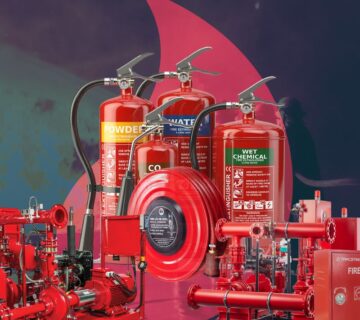

When the renewal of your commercial license or Civil Defense license depends on just one document, this document becomes the most important paper in your entire facility file. This document is a safety report, which is the bridge that connects the actual reality of your facility with the approval of official authorities to continue your business. Any delay or error in it means delaying the license itself, and sometimes stopping the activity completely.
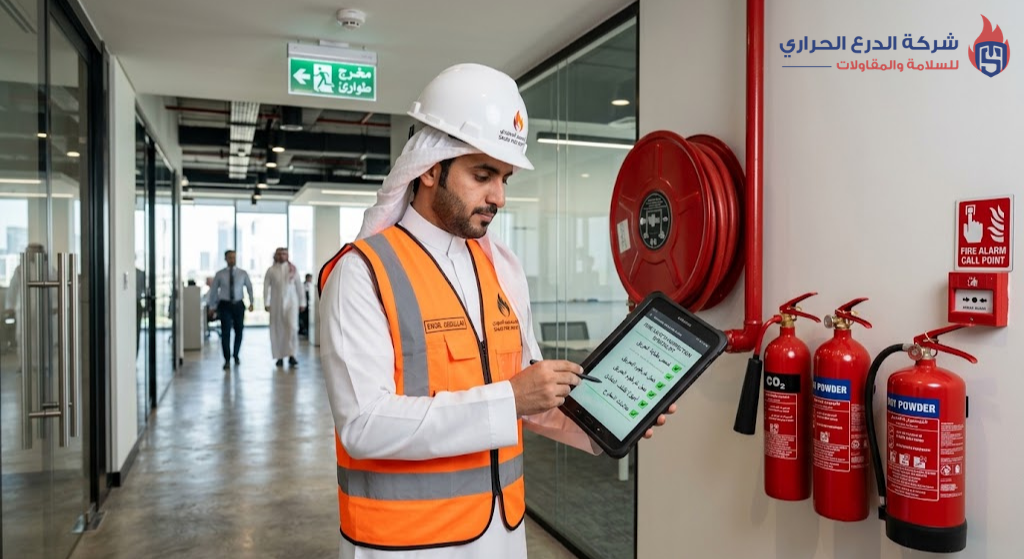
Table of Contents
- What is a Safety Report?
- Why It Is Indispensable
- Difference Between a Safety Report, Safety Certificate, and Civil Defense License
- When Does Your Facility Need a Safety Report?
- Steps to Issue an Approved Safety Report with Thermoshield
- What Does a Technical Safety Report Include?
- Why Thermoshield Specifically?
- Consequences of Neglecting or Delaying a Safety Report
- Practical Tips for First-Time Safety Report Approval
- Frequently Asked Questions About the Safety Report
- Request Your Facility’s Safety Report Now
📞 Call Us |
What is a Safety Report?
A safety report is a certified engineering technical document issued by an office or company licensed by Civil Defense, documenting the extent to which your facility complies with the prevention and safety requirements applicable in the Kingdom. This report is issued after an actual site inspection, which includes checking alarm and firefighting systems, emergency exits, instructional signage, and firefighting tools available inside the facility.
In other words, a safety report is official proof that your facility is ready to handle any emergency and does not pose a danger to those inside it or to neighboring buildings. For this specific reason, a safety report is required as a basic prerequisite for issuing or renewing a municipal license via the Balady platform, and sometimes for issuing a Civil Defense license via the Salamah portal, depending on the nature of the activity and its area.
Why It Is Indispensable
- Without a valid safety report, licensing or renewal procedures for most commercial and industrial activities cannot be completed.
- The report protects the facility owner legally, because it proves that they have taken the required preventive measures.
- The report reduces the likelihood of fire accidents or injuries, because it detects weaknesses before they turn into a real problem.
- In the event of an accident, a valid safety report is one of the documents required to prove the facility’s compliance.
Difference Between a Safety Report, Safety Certificate, and Civil Defense License
Many facility owners confuse three different documents, even though each of them has a specific function:
- Safety Report: A technical document that records the facility’s condition at the time of inspection, and is used only once in a specific transaction, whether issuing a new license or renewing an existing license.
- Safety Certificate (or Safety Tools Certificate): Proves that the facility has actually purchased and installed the necessary prevention tools, such as extinguishers and smoke detectors, and remains valid for one year from the date of its issuance or first use.
- Civil Defense License: The final license that grants the facility official status to operate from a security and preventive standpoint, and is extracted after fulfilling both the safety report and the safety tools certificate according to activity requirements.
Understanding this difference is very important, because many renewal requests are disrupted due to submitting one document instead of another, or not realizing that a safety report is valid for single use only and cannot be reused in another transaction after its purpose has ended.
When Does Your Facility Need a Safety Report?
There are specific cases in which obtaining a safety report becomes inevitable:
When Issuing a New Commercial License
Some activities, such as restaurants, cafes, warehouses, and factories, are classified among activities that require a mandatory safety report before extracting a municipal license for the first time, regardless of the facility size.
When Renewing an Existing License
As the municipal license or Civil Defense license approaches its expiration, the facility owner is required to submit a new safety report reflecting the current state of the facility, especially if any change has occurred in area, activity, or interior partitions.
When Changing Activity or Expanding
Any fundamental modification in the nature of work, increase in utilized space, or addition of a new activity within the same facility requires extracting an updated safety report showing the suitability of prevention systems for the new situation.
When Remarks Arise from Civil Defense
If a Civil Defense inspector visits the site and records remarks regarding firefighting or alarm systems, the solution is usually to correct the remarks and then extract a new safety report documenting the rectification.
📞 Call Us |
Steps to Issue an Approved Safety Report with Thermoshield
At Thermoshield Safety and Contracting Company, the process of issuing your facility’s safety report goes through clear and studied stages, without complexity and without last-minute surprises:
Step One: Reviewing Facility Data
Our team begins by reviewing the commercial registration, activity type, and facility area, to determine the exact requirements stipulated by Civil Defense specifically for this type of activity. This step later determines whether your facility needs an immediate or non-immediate safety report.
Step Two: Field Inspection
A specialized technical team visits the site to check the actual condition of alarm and firefighting systems, emergency exits, and instructional signage, and to ensure their compliance with the required conditions. Any deficiency or defect monitored at this stage is explained to the facility owner immediately with a proposal for the appropriate solution.
Step Three: Addressing Remarks If Any
In the event of deficiencies, such as an expired extinguisher or an ineffective smoke detector, the team provides quick solutions for supply, safety systems maintenance, or installation, until the facility is fully ready to meet requirements before uploading the report.
Step Four: Preparing and Uploading the Report Electronically
After ensuring that all requirements are met, the engineering team prepares a documented safety report and uploads it electronically via the company’s approved account on the Salamah platform, so that it is automatically linked to the facility number and its commercial registration.
Step Five: Handing Over the Report Number to the Client
Once the report is approved, the facility owner receives a safety report number that they can enter directly into their account on the Balady portal or Salamah portal, to complete the issuance or renewal of the required license without the need for any additional paper reviews.
What Does a Technical Safety Report Include?
In order for your facility’s safety report to be accepted immediately upon submission, it must contain accurately specified elements:
- The facility’s unified number linked to the commercial registration.
- The detailed site address and geographical region.
- The total area of the facility, because it determines the type and quantity of safety tools required.
- The commercial activity code, because it determines the degree of risk and the requirements specific to each activity.
- The date of conducting the actual site inspection.
- The result of the field inspection, clarifying whether firefighting and alarm systems are intact or in need of intervention.
Any omission in one of these elements may lead to the rejection of the safety report when uploaded to the platform, and for this reason, accuracy of preparation is no less important than the accuracy of the inspection itself.
Why Thermoshield Specifically?
Choosing the entity that issues your facility’s safety report is not a procedural formality, because this entity bears technical responsibility for data accuracy before Civil Defense. At Thermoshield Safety and Contracting Company, we combine several elements that make this process faster and safer for the facility owner:
- An experienced engineering team that understands Saudi Building Code requirements and Civil Defense standards accurately, in addition to consulting international codes like NFPA and IEC when needed.
- Integration of services under one roof; the company does not limit itself to preparing the safety report only, but also provides supply, installation, and maintenance of alarm and firefighting systems, design of safety drawings, backup lighting, fire doors, evacuation plans, and industrial security systems, which means that any deficiency discovered during inspection can be addressed immediately without searching for another supplier.
- Direct electronic submission via the company’s approved account on the Salamah platform, which saves time and reduces the likelihood of errors resulting from dealing with multiple intermediaries.
- Post-issuance follow-up through periodic maintenance programs ensuring that the facility remains compliant with requirements until the next renewal date.
Consequences of Neglecting or Delaying a Safety Report
Ignoring the extraction of a safety report at the right time does not only mean delaying an administrative transaction, but has actual repercussions on business continuity:
- Disruption of commercial license issuance or renewal, which may expose the facility to closure or fines.
- The facility remains without actual coverage by sound alarm and firefighting systems, which raises the possibility of material and human losses when any emergency occurs.
- Loss of confidence before financing entities or insurance companies that sometimes require valid safety documents within the facility file.
- Restarting the entire procedure from scratch in case the inspection validity expires before using the report, because the safety report has a specific purpose and cannot be retained for repeated uses.
Practical Tips for First-Time Safety Report Approval
- Make sure the commercial registration is valid before starting procedures, as any defect in its data disrupts linking the safety report to the facility.
- Do not postpone the maintenance or replacement of old safety tools, as an expired extinguisher or a broken detector is among the most common reasons for inspection rejection.
- Ensure that the area registered in the commercial registration matches the actual facility area completely, because any difference directly affects the type of required conditions.
- Keep a copy of every previous safety report, as you may need it as a reference for any future modification in activity.
- Deal only with an entity accredited by Civil Defense, because a safety report issued by an unlicensed entity is not accepted at all on official platforms.
Frequently Asked Questions About the Safety Report
Can a safety report be modified after issuance?
Safety report data cannot be modified after approval. In the event of an error in entered data, a completely new report is issued instead of modifying the previous one.
How long is the safety report valid?
The safety report reflects the facility’s condition at the time of inspection only, and its purpose ends once it is used in the transaction for which it was issued, whether issuing a new license or renewing an existing license.
Does Civil Defense visit the site after the safety report is issued?
The engineering entity that issued the report bears full responsibility for the accuracy of its data before Civil Defense, and a subsequent field visit may take place according to the discretion of Civil Defense and the nature of the activity.
What is the difference between an immediate and non-immediate safety report?
The immediate report pertains to lower-risk activities and limited areas, such as some small restaurants and cafes, while the non-immediate report pertains to higher-risk activities or larger areas, and requires more detailed inspection procedures.
Can the same safety report be used on more than one platform?
The technical safety report is used via the Balady platform in case of needing a municipal license, while it is used via the Salamah portal in case of needing a Civil Defense license only, and a single copy of the report may not be used for two different transactions.
What is the most important data required to issue a safety report?
The most important are the activity code, unified commercial registration number, facility address, and its actual area, alongside the field inspection result of firefighting and alarm systems to prepare the conditions.
📞 Call Us |
Request Your Facility’s Safety Report Now
Your facility deserves dealing with an entity that understands that a safety report is not merely a paper uploaded to a platform, but a real reflection of workplace readiness to protect those inside it. The team at Thermoshield Safety and Contracting Company is ready to inspect your facility, determine what it needs accurately, and issue an approved safety report that connects you to your license without disruptions and without surprises.
Contact Thermoshield Company today via its website to book an inspection appointment, and obtain your facility’s safety report as quickly as possible, with the highest standards of accuracy and official certification.

Importance of Compliance Certificates for Safety Plans: