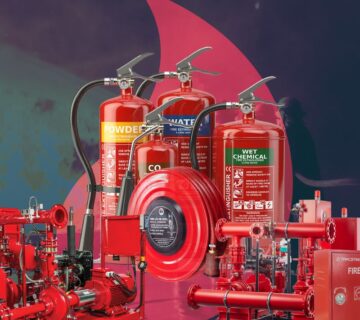

Risk assessment is the first step separating a safely operating facility from one exposed to an incident that could halt its entire operation. Every factory, warehouse, or commercial building contains potential hazard sources—whether electrical, mechanical, or fire-related—and these hazards cannot be managed without an accurate technical study determining their scale and remediation priorities.
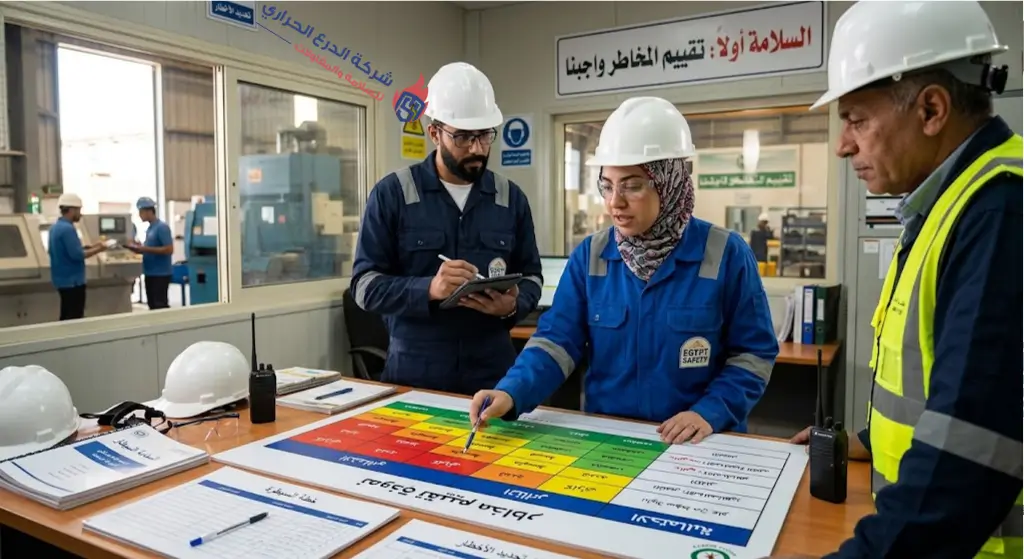
Table of Contents
- What is Risk Assessment?
- What is the Difference Between Risk Assessment and Risk Management?
- What are the Core Elements of Risk Assessment?
- Why is Risk Assessment Mandatory for Saudi Facilities?
- Which Authorities are Linked to Risk Assessment in Saudi Arabia?
- Is Risk Assessment Mandatory for All Facilities or Only Industrial Ones?
- Practical Steps of Risk Assessment
- Types of Hazards Covered by Risk Assessment
- Who Actually Needs Risk Assessment?
- When Should Risk Assessment be Re-evaluated?
- How to Choose a Reliable Entity for Risk Assessment Execution?
- Why Facilities in Jeddah and Saudi Arabia Rely on Thermoshield for Risk Assessment?
- Factors Influencing the Cost of Risk Assessment
- Frequently Asked Questions
- Conclusion
📞 Call Us |
What is Risk Assessment?
Risk assessment is a systematic process for identifying hazard sources within the workplace, analyzing the probability of their occurrence, measuring the expected scale of damage, and establishing practical measures to mitigate or eliminate them before turning into an actual incident.
In simpler terms: instead of waiting for a fire outbreak or occupational injury and reacting to the aftermath, a specialized technical team audits the facility in advance, identifies every potential vulnerability, and compiles it into a documented report outlining the risk level and priority tier for every item.
What is the Difference Between Risk Assessment and Risk Management?
Risk assessment is solely the diagnostic stage: detecting, analyzing, and classifying hazards. Risk management is the broader framework encompassing assessment alongside developing, implementing, and regularly reviewing preventive action plans. In other words, risks cannot be managed effectively without an accurate risk assessment backing managerial decisions.
What are the Core Elements of Risk Assessment?
Any professional risk assessment study consists of four indispensable pillars:
- Hazard Identification: What is the specific hazard source?
- Likelihood: What is the probability of occurrence?
- Severity: What is the scale of anticipated impact on personnel and assets?
- Preventive Control: What practical solution controls or eliminates this hazard?
Why is Risk Assessment Mandatory for Saudi Facilities?
The direct answer: because Saudi statutory regulations strictly mandate it upon employers, making it an enforced legal compliance rather than an optional measure.
Chapter Eight of the Saudi Labor Law, regarding occupational hazard prevention, mandates employers to implement necessary precautions to protect workers from occupational injuries and diseases. Achieving this requires a risk assessment identifying exactly where vulnerabilities lie. Additionally, the General Directorate of Civil Defense mandates submitting accredited safety reports and blueprints prior to issuing operational licenses for commercial and industrial facilities, which intrinsically rely on risk assessment outcomes and meeting safety and security requirements.
Which Authorities are Linked to Risk Assessment in Saudi Arabia?
- Ministry of Human Resources and Social Development: Through Occupational Safety and Health regulations.
- General Directorate of Civil Defense: Through safety and fire prevention regulations and statutory licensing.
- National Council for Occupational Safety and Health: Overseeing general workplace environment safety policies.
Is Risk Assessment Mandatory for All Facilities or Only Industrial Ones?
The mandate applies to any facility employing a workforce or housing hazardous activities, whether it is a factory, warehouse, commercial building, or construction site. The required level of detail varies based on activity nature and facility scale, but the core principle of risk assessment does not exempt any sector involving direct interaction between workers and hazard sources.
📞 Call Us |
Practical Steps of Risk Assessment
The process of risk assessment is not merely a rapid inspection walk, but an integrated technical methodology proceeding through specific stages:
Step One: Identifying Site Hazard Sources
The engineering team starts with a comprehensive on-site survey documenting every potential hazard: unsafe electrical connections, combustible materials, heavy machinery, obstructed emergency exits, or malfunctioning alarm panels. This stage defines the entire scope of the risk assessment, as any unrecorded hazard will not appear in the final report.
Step Two: Analyzing Likelihood and Severity
Each identified hazard is evaluated against two parameters: probability of occurrence (Rare, Possible, Probable) and impact severity (Minor, Moderate, Catastrophic). The intersection of these metrics forms the Risk Matrix, classifying each hazard into clear levels: Low, Medium, High, or Critical.
Step Three: Prioritizing Risks
Following classification, risks are prioritized by urgency. Hazards categorized as "Critical" demand immediate intervention, whereas "Low" risks can be scheduled into routine monitoring plans without halting operations. This prioritization prevents squandering resources on secondary issues while major hazards remain unresolved.
Step Four: Establishing Preventive Measures
For each categorized risk, actionable technical controls are prescribed, such as:
- Replacing or maintaining substandard machinery.
- Installing or upgrading early detection and firefighting systems and executing safety systems maintenance programs.
- Training personnel on handling hazard sources.
- Revising evacuation pathways or adding emergency doors in accordance with the approved safety plan.
- Mandating Personal Protective Equipment (PPE) within designated hazard zones.
Step Five: Documentation and Report Issuance
All findings are consolidated into a certified technical report detailing hazard descriptions, classifications, recommended corrective controls, and an implementation timeline. This report serves as official proof submitted to regulatory bodies and acts as an ongoing operational benchmark for management.
Step Six: Ongoing Monitoring and Periodic Review
Risk assessment is not a one-time static document archived after completion. Work environments continuously evolve: new equipment, structural expansions, staffing shifts, or operational adjustments all necessitate reviewing and updating the study.
Types of Hazards Covered by Risk Assessment
Risk assessment is comprehensive, covering multiple interconnected operational domains across the facility:
- Electrical Hazards: Damaged cabling, overloaded circuits, unshielded distribution panels.
- Fire Hazards: Flammable substances, absence or failure of alarm and suppression systems.
- Mechanical Hazards: Heavy machinery, exposed moving/rotating components.
- Environmental Hazards: Chemical leakages, hazardous gases, excessive noise or thermal radiation.
- Structural Safety Hazards: Defective ceilings, uncertified scaffolding, insufficient emergency exits.
- Security Hazards: Unmonitored access points, lack of functional CCTV and industrial security measures.
Each hazard category requires specific analytical criteria, which is why a robust risk assessment demands a multidisciplinary engineering team rather than generic evaluations.
Who Actually Needs Risk Assessment?
In short: nearly every operating facility, though the need is most critical across specific sectors:
Factories and Industrial Facilities
They encompass diverse hazards: electrical, mechanical, chemical, and fire risks. Here, risk assessment is an essential condition for securing operating permits and issuing the mandatory safety and security license.
Warehouses and Hangars
Housing large quantities of goods and potentially flammable materials across open layouts, requiring clear evacuation paths and reliable early warning systems.
Commercial and Office Buildings
Although operational hazards appear lower than in plants, accommodating large occupant volumes makes evacuation readiness and fire prevention top priorities for issuing a certified safety report.
Construction Sites
Dynamic environments involving scaffolding, heavy machinery, and working at heights. Risk assessment here requires continuous updates aligned with construction progress rather than a single static report.
When Should Risk Assessment be Re-evaluated?
Specific operational triggers necessitate immediate re-evaluation without delay:
- Initial commissioning of the facility before admitting personnel or customers.
- Expanding operations or introducing new machinery and production lines.
- Following any safety incident, regardless of severity, to uncover root causes and prevent recurrence.
- During Civil Defense license renewal, required periodically.
- Substantial changes in workforce volume or operational workflows within the facility.
Neglecting these milestones means the existing report no longer reflects actual site conditions, rendering the risk assessment practically obsolete.
How to Choose a Reliable Entity for Risk Assessment Execution?
Before hiring any engineering office or firm, verify the following credentials:
- Official Civil Defense accreditation to issue safety reports and blueprints.
- A multidisciplinary engineering team rather than a single generalist engineer.
- Documented field experience in the exact activity type (industrial, commercial, or construction).
- A clear, structured report detailing risk rankings and actionable recommendations rather than vague remarks.
- Post-handover follow-up services rather than a one-off assessment.
These standards represent the real difference between a superficial risk assessment used merely for paperwork compliance and an authentic study protecting the business from severe financial and human losses.
Why Facilities in Jeddah and Saudi Arabia Rely on Thermoshield for Risk Assessment?
Thermoshield Safety and Contracting Company, headquartered in Mushrefah District in Jeddah, specializes in providing comprehensive risk assessment studies within an integrated ecosystem of safety solutions: fire alarm and suppression systems, Civil Defense licensing, and technical engineering certifications.
What sets Thermoshield apart is delivering risk assessment as part of an end-to-end execution path: starting from hazard surveys, through probability/severity modeling, to designing protection systems and directly obtaining Civil Defense approvals. This ensures risk assessment results translate into actionable engineering solutions rather than remaining unutilized reports.
Our team comprises specialized engineers in fire alarms, fire pumps, emergency doors, and surveillance systems, ensuring our risk assessment is grounded in deep technical engineering across every facility asset.
Factors Influencing the Cost of Risk Assessment
There is no static price for risk assessment, as pricing correlates directly with several factors:
- Facility area and total count of buildings/divisions audited.
- Operational nature: high-risk industrial plants versus low-risk commercial units.
- Total workforce and degree of direct interaction with hazard sources.
- Requirement for specialized sub-studies such as fire plume modeling or gas dispersion analysis.
The accurate path to determining costs is requesting an initial site inspection, based on which a detailed technical proposal reflecting the exact scope is generated.
Frequently Asked Questions
How long does a risk assessment study take?
It depends on facility size and complexity. A small commercial space may require a few days, whereas a multi-department industrial factory may take several weeks to comprehensively audit all hazards.
Is risk assessment a prerequisite for a Civil Defense license?
Yes, technical safety reports and engineering plans submitted to Civil Defense are fundamentally built upon risk assessment findings, serving as the blueprint for required alarm and suppression systems.
Can risk assessment be performed internally without a specialized company?
Theoretically, internal safety officers can handle preliminary monitoring; however, the officially accredited study required for statutory licensing and insurance requires a Civil Defense-licensed entity with technical expertise and engineering tools.
What is the difference between a risk assessment and a safety report?
Risk assessment is the technical analysis and classification process, whereas the safety report is the final legal document certifying compliance for official authority submission.
Does the risk assessment method differ between factories and offices?
Yes, industrial plants prioritize mechanical, chemical, and fire load hazards, whereas office environments focus primarily on evacuation routes, electrical system integrity, and occupant density.
How often should risk assessments be updated?
As a general rule, re-evaluating the study periodically in conjunction with license renewals is recommended, or immediately upon structural expansions or safety incidents.
📞 Call Us |
Conclusion
Risk assessment is not a routine procedure completed for paperwork compliance; it is the cornerstone upon which all facility safety decisions are built—from suppression engineering to workforce drills and egress design. A facility armed with an accurate, updated risk assessment study preempts emergencies rather than managing aftermaths, making all the difference in safeguarding lives, assets, and business reputation.
If your facility requires an approved risk assessment study backed by real engineering expertise, the team at Thermoshield Safety and Contracting in Jeddah is prepared to inspect your location and compile the full technical study—from hazard identification to protective design and Civil Defense approvals.

Providing recommendations for effective risk management, especially in projects under construction