

Operating industrial facilities, warehouses, and strategic assets in Saudi Arabia requires strict adherence to mandatory industrial security requirements designed to safeguard personnel, infrastructure, and investments from fire hazards and operational risks. Non-compliance with these engineering benchmarks leads directly to operational license rejection, severe regulatory fines, or mandatory facility shutdown by governing authorities.
Quick Summary: Saudi industrial security requirements comprise mandatory technical and engineering standards enforced by the High Commission for Industrial Security (HCIS) alongside the Saudi Building Code (SBC 801). Facilities must implement certified fire compartmentation, structural steel fireproofing rated for 2 to 4 hours, approved firestopping systems, and Class A non-combustible insulation materials.
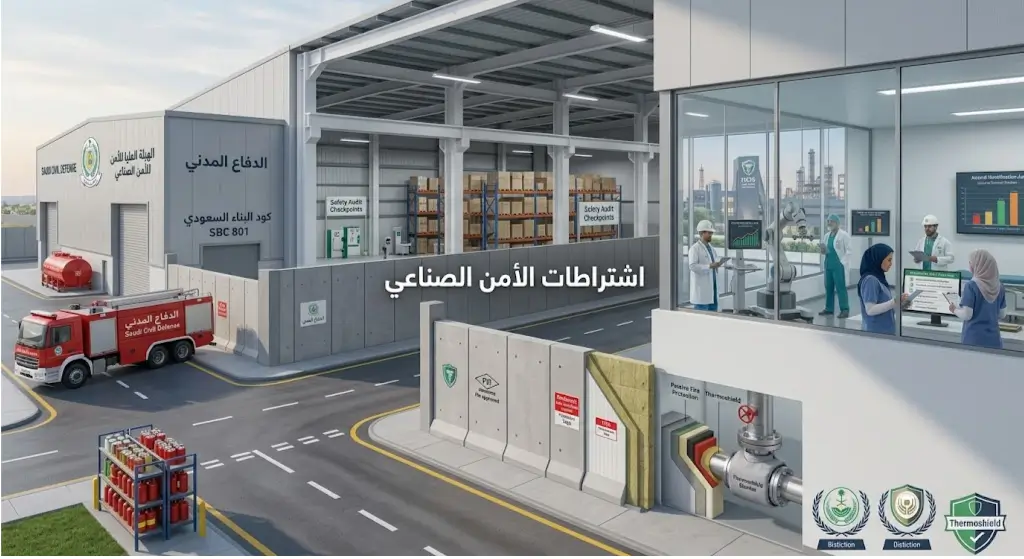
What Are the Approved Industrial Security Requirements in Saudi Arabia?
Industrial security requirements establish the structural, engineering, and operational framework governing facilities supervised by HCIS and the General Directorate of Civil Defense. Compliance requires an integrated safety ecosystem comprising:
- Fire Compartmentation: Dividing plant zones into isolated fire sectors to prevent fire, smoke, and toxic gas propagation across operational wings.
- Passive Fire Protection (PFP): Encapsulating load-bearing structural steel members with intumescent coatings or fire-rated wraps offering 2 to 4 hours of fire endurance.
- Firestopping Systems: Sealing all service penetrations (cables, cable trays, and pipes) passing through fire barriers using tested, fire-resistant compounds.
- Non-Combustible Thermal Insulation: Installing building insulation materials with certified low flame spread and smoke development ratings.
Regulatory Authorities Governing Industrial Safety Requirements
Three primary regulatory entities establish and inspect industrial security and safety compliance across the Kingdom:
- High Commission for Industrial Security (HCIS): The governing authority setting mandatory Security, Safety, and Fire Protection Directives for petroleum, petrochemical, and strategic industrial infrastructure.
- Saudi Building Code National Committee (SBC): The legislative body establishing architectural and fire engineering standards, primarily through SBC 801 (Fire Code) and SBC 201 (General Code).
- General Directorate of Civil Defense: The field regulatory authority responsible for inspections, compliance audits, and issuing final commercial safety permits.
HCIS Directives and Facility Risk Classifications
HCIS enforces Safety (SAF) and Fire Protection (FIRE) directives categorized according to facility operational hazard tiers:
Facility Hazard Classifications under HCIS:
- Class A (High Risk): Petrochemical plants, oil refineries, power generating stations, and major strategic energy infrastructure.
- Class B (Medium Risk): Heavy manufacturing facilities, chemical warehouses, and mid-sized industrial processing plants.
- Class C (Low/Moderate Risk): Standard fabrication workshops, dry storage warehouses, and secondary logistical support hubs.
| HCIS Hazard Classification | Facility Scope & Operational Nature | Required Fire Resistance Rating |
|---|---|---|
| Class A (High Risk) | Petrochemicals, gas processing, strategic energy plants | 3 to 4 Hours (Certified Fire Wall) |
| Class B (Medium Risk) | Manufacturing plants, chemical storage, assembly lines | 2 to 3 Hours (Fire Barrier) |
| Class C (Low/Moderate) | Light manufacturing, logistics warehouses, packaging | 1 to 2 Hours (Fire Partition) |
Core Mandates of HCIS SAF Directives:
- Isolating control rooms and administrative buildings from hazardous processing zones with minimum 3-hour fire barriers.
- Applying structural passive fire protection to all steel supports under pressurized process vessels and flammable product piping.
- Designing protected egress pathways insulated to eliminate radiant heat exposure during emergency evacuation.
| 💬 Consultation (1) | 💬 Site Audit (2) |
Engineering Insulation Standards Under the Saudi Building Code (SBC 801)
SBC 801 establishes technical specifications for building envelopes, partition walls, and thermal insulation to prevent fire propagation:
1. Structural Fire Resistance Ratings
- Load-Bearing Steel Structures: Because structural steel weakens rapidly under extreme thermal loads, the code mandates protection via intumescent coatings or thermal wraps rated for 2 to 4 hours per ASTM E119 and UL 263 standards.
- Compartment Fire Barriers: Concrete or approved fire-rated wall assemblies installed to physically segregate manufacturing lines and high-hazard storage.
2. Fire-Resistant Thermal and Waterproofing Specifications
- Flame Spread Index (FSI): All insulation materials must achieve a Class A rating per ASTM E84 testing (Flame Spread Index between 0 and 25).
- Smoke Developed Index (SDI): Total smoke output must remain below 450 to maintain clear escape visibility.
- Thermal Resistance and Stability: Insulation systems must maintain low thermal conductivity without deteriorating under environmental exposure.
Active vs. Passive Fire Protection Systems
Understanding inspection expectations requires distinguishing between active and passive fire systems:
| Evaluation Metric | Active Fire Protection (AFP) | Passive Fire Protection (PFP) |
|---|---|---|
| Operational Principle | Automated or manual systems requiring sensor activation, electricity, or mechanical action upon fire breakout. | Built-in structural components providing permanent, passive resistance 24/7 without external power sources. |
| Core Examples | Automatic fire sprinklers, smoke detectors, deluge systems, and gas suppression networks. | Intumescent fireproof paint, fire-rated insulation, fire dampers, and certified penetration seals (Firestop). |
| Primary Function | Direct fire suppression, cooling, and active extinguishing. | Containing fires within initial zones, preserving structural integrity, and securing evacuation routes. |
| Compliance Requirements | Periodic maintenance contracts and hydraulic flow test logs. | Accredited third-party laboratory testing certificates (UL Listed, FM Approved) and engineering installation logs. |
| Thermoshield Specialty | Engineering alignment for active mechanical runs. | Core Focus: Supplying and applying fully accredited passive fire protection and firestopping systems. |
Industrial Security Standards for Warehouses and Storage Facilities
Warehouses present major fire hazards due to high storage load densities and accelerated fire spread risks:
- Volume Compartmentation: SBC 801 restricts maximum undivided floor areas, mandating vertical fire walls extending beyond roof lines with at least 3 hours of fire resistance.
- Sandwich Panel Integrity: Combustible cores (such as unclassified EPS) are strictly banned. Facilities must install FM Approved panels filled with rockwool or polyisocyanurate (PIR).
- Exit Access Travel Distances: Maximum egress travel distances must not exceed 45 meters, supported by fire-rated corridors and certified emergency doors.
Special Safety Directives for High-Hazard Industrial Plants
Plants handling petrochemicals, volatile solvents, or heavy thermal processes require enhanced safety configurations:
- Hydrocarbon Fire Resistance (UL 1709): Structural members exposed to rapid-ignition fuel fires must feature specialized hydrocarbon-rated thermal protection.
- Smoke Evacuation & Dampers: Ducting crossing fire boundaries must include automated, insulated fire/smoke dampers to prevent cross-facility fire movement.
- Secondary Containment Linings: Floor coatings around chemical vessels must resist chemical breakdown and prevent soil contamination during leaks.
How Thermoshield Ensures Complete Compliance with Industrial Security Standards
Thermoshield delivers turn-key technical solutions enabling industrial facilities across Saudi Arabia to secure regulatory clearances efficiently:
1. Certified Non-Combustible Thermal Insulation Systems
Thermoshield provides advanced insulation solutions offering superior energy conservation and certified Class A fire performance, eliminating flame propagation risks and toxic off-gassing.
2. Passive Fire Protection & Firestopping Systems
- Structural Steel Protection: Fire-resistant coatings protecting steel beams and columns from structural failure during prolonged fires.
- Certified Penetration Firestops: Full engineering sealing of openings around electrical cables, conduits, and mechanical pipework passing through fire separations for up to 4 hours of protection.
| 💬 Sales Desk (1) | 💬 Technical Desk (2) |
Hazard Identification Audit (HAZID) Workflow
HCIS compliance mandates detailed hazard assessment documentation structured across four technical stages:
- Site Hazard Mapping: Cataloging combustible substances, open heat sources, and heavy operational equipment.
- Fire Load Density Calculations: Determining total thermal potential per square meter to specify required barrier thicknesses and resistance ratings.
- Barrier & Insulation Inspections: Examining plant envelopes to discover unsealed voids or uncertified insulation materials.
- Remediation Engineering Report: Formulating corrective schedules and deploying certified passive protection solutions.
Critical Engineering Failures Resulting in Licensing Delays
Audits by HCIS and Civil Defense frequently identify recurring compliance defects:
1. Utilizing Unrated or Combustible Insulation:
Risk: Installing unapproved panels lacking Class A certification leads to immediate inspection failure and mandatory removal.
Solution: Deploying Thermoshield systems fully supported by accredited local and international lab test certificates.
2. Unsealed Service Penetrations (Firestop Failures):
Risk: Unprotected cable runs and pipe sleeves compromise fire walls, allowing rapid heat and smoke bypass.
Solution: Installing tested, multi-hour certified firestop seals across all barrier penetrations.
3. Unprotected Structural Steel Elements:
Risk: Bare steel frames warp and lose integrity in under 20 minutes during structural fires.
Solution: Applying certified intumescent paint or encasement wraps providing 2 to 4 hours of structural stability.
Pre-Audit Engineering Checklist
Verify facility compliance against this checklist before formal HCIS or Civil Defense visits:
- Hazard tier classification (Class A / B / C) documented with approved layouts.
- Material test certificates verified for all thermal insulation (Class A rating).
- Fire wall continuity confirmed with zero unsealed cracks or voids.
- Approved firestop systems applied across all electrical and plumbing penetrations.
- Steel frames encapsulated with certified fire-rated coatings.
- Evacuation routes secured with fire doors and insulated wall assemblies.
- Stamped engineering compliance reports prepared by certified consultants.
How Thermoshield Prepares Your Facility for Approval
Thermoshield provides end-to-end engineering support to ensure smooth facility approvals:
- Free Comprehensive Site Audit: On-site inspection identifying passive fire protection gaps and code mismatches.
- Engineering Analysis & Design: Determining precise fire-resistance metrics per SBC 801 and HCIS standards.
- Certified Supply & Installation: Professional application executed by certified field specialists.
- Regulatory Documentation Handover: Compiling test certificates and calculation sheets to facilitate immediate industrial security license renewal and issuance.
FAQ
What is the difference between HCIS and Civil Defense regulations?
HCIS governs high-risk, vital strategic facilities through specialized security and safety directives, whereas Civil Defense enforces general Saudi Building Code fire safety regulations across commercial and standard industrial sites.
What fire resistance ratings are required for warehouse roofs and walls?
Under SBC 801, warehouse boundary and interior separation fire ratings range between 2 to 4 hours depending on warehouse volume, height, and storage commodity hazards.
Is standard thermal insulation acceptable under SBC 801?
No. Thermal insulation must be certified non-combustible with an ASTM E84 Class A rating; uncertified insulation is non-compliant and prohibited.
What is passive fire protection (PFP)?
PFP refers to built-in materials and designs that limit fire and smoke spread while sustaining building load capacity without active human or mechanical intervention.
Why are firestop systems vital during safety audits?
Firestops prevent toxic smoke and flames from crossing through cable and pipe penetrations; missing firestops invalidate the certification of entire fire wall assemblies.
What are the consequences of non-compliance with industrial safety standards?
Penalties include operational stop-orders, substantial financial fines, and refusal to issue or renew commercial licenses until complete remediation.
Conclusion
Meeting industrial security requirements and Saudi Building Code standards is essential to protect personnel, preserve capital assets, and maintain uninterrupted commercial operations. Thermoshield guarantees dependable compliance through certified insulation, structural steel fireproofing, and firestopping systems approved by HCIS and Civil Defense. Connect with our engineering specialists today to book your on-site audit.
| 💬 Line 1 (Primary) | 💬 Line 2 (Support) |
No comment