

The efficiency of any commercial or industrial facility in fire protection relies on precise engineering design and selecting smoke and heat detectors in accordance with international and local building codes to ensure immediate response and minimize potential losses.
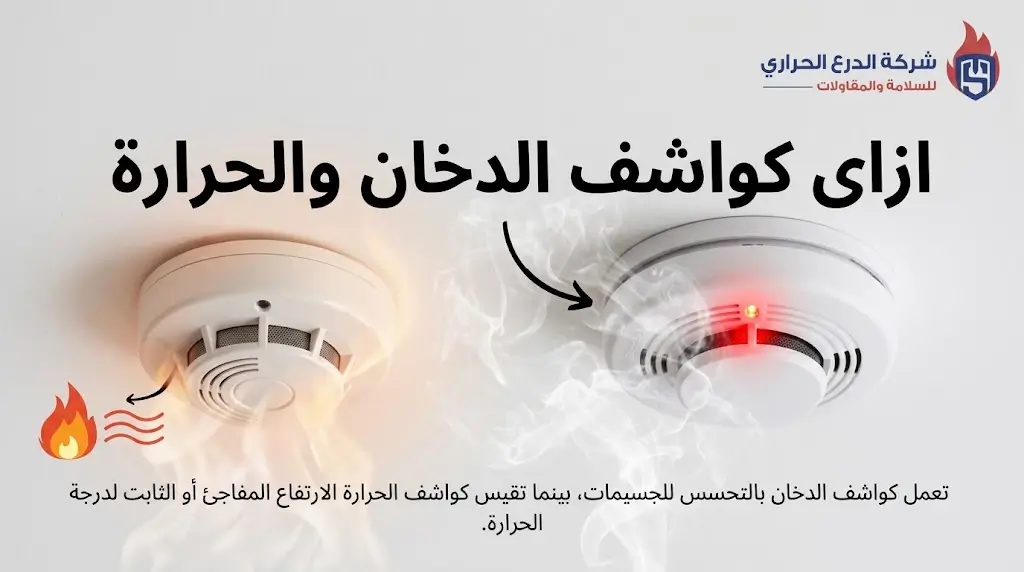
Table of Contents
- Decisive Answer, Rapid Response, and Technical Performance Standards
- Early Warning Network Engineering and Its Importance
- The Difference Between Smoke Detectors and Heat Detectors
- Technical and Photoelectric Detector Types
- Fixed Temperature and Rate-of-Rise Heat Sensors
- Advanced Multi-Criteria Detectors
- False Alarm Mitigation and Fire Behavior
- Control Panels and Addressable Alarm Systems
- Standards for Installing, Distributing, and Covering Fire Detectors
- Periodic Maintenance and Detection Equipment Testing
- Thermoshield Company Services and Certified Reports
- Frequently Asked Questions (FAQ)
- Conclusion
Call Us |
Decisive Answer, Rapid Response, and Technical Performance Standards
Engineering selection criteria for smoke and heat detectors systems rely on risk assessment for each zone; optical detectors are placed in corridors and offices, while heat sensors are positioned in kitchens and parking structures to ensure comprehensive, fast-responding coverage for all combustion byproducts.
Early Warning Network Engineering and Its Importance
Early warning networks are the primary nerve center of any protection system; smoke and heat detectors act as the first line of defense by discovering smoke or abnormal temperature rises in the initial moments of fire outbreak, allowing building evacuation and automatic suppression activation with high precision.
The Difference Between Smoke Detectors and Heat Detectors
Smoke detectors sense combustion particles suspended in the air whether visible or invisible, making them ideal for rapid response to slow-burning fires. In contrast, heat detectors react exclusively to thermal changes resulting from fast-burning fires and are unaffected by dust or light vapors.
Technical and Photoelectric Detector Types
Optical smoke detectors utilize light beam projection inside the sensing chamber; when smoke particles enter, light scatters to strike the sensing cell and triggers the alarm instantly. This type features high effectiveness in detecting fires producing large amounts of cool smoke before actual flames appear.
Fixed Temperature and Rate-of-Rise Heat Sensors
Fixed temperature heat sensors rely on internal thermostats closing the electrical circuit once heat reaches a standard threshold (e.g., 58°C). Rate-of-rise detectors monitor temperature increase speed and activate if heat rises exceeding 8°C per minute regardless of absolute value.
Call Us |
Advanced Multi-Criteria Detectors
Multi-criteria detectors combine optical and thermal elements into a single unit with microprocessors for environmental data analysis, raising real fire detection efficiency and reducing false alarms caused by water vapor or airborne dust in complex industrial environments.
False Alarm Mitigation and Fire Behavior
False alarms in smoke and heat detectors often result from dust accumulation, cooking vapors, or high humidity in unsuitable sensors. Thermoshield resolves this issue by studying activity nature, selecting appropriate categories, and programming panel sensitivity per approved codes.
Control Panels and Addressable Alarm Systems
Smoke and heat detectors in modern systems link to an addressable Fire Alarm Control Panel (FACP) allowing millimetric location tracking of each detector during emergencies, directing rapid response teams accurately without wasting precious time.
Standards for Installing, Distributing, and Covering Fire Detectors
Installing smoke and heat detectors is subject to precise engineering requirements including maximum ceiling height, distance from AC diffusers and strong drafts, and avoiding dead corners to ensure combustion byproducts reach sensing chambers smoothly without obstruction.
A standard detector unit covers approximately 80 to 100 square meters for open areas with flat ceilings, provided the distance between any ceiling point and the nearest detector does not exceed approved coverage radii, reducing these distances in narrow corridors or structural obstacles.
Periodic Maintenance and Detection Equipment Testing
Alarm networks require periodic inspections including standard smoke and heat simulation testing, cleaning detector optical chambers, and checking standby battery voltage to ensure continuous network efficiency year-round without sudden failures.
Thermoshield Company Services and Certified Reports
Smoke and heat detectors approved via Thermoshield solutions deliver top safety standards certified by Civil Defense, supported by precise technical reports and comprehensive maintenance contracts ensuring facility readiness for emergencies.
Frequently Asked Questions
What is the main difference between a smoke detector and a heat detector?
A smoke detector senses suspended air combustion particles for early slow fire response, whereas a heat detector reacts to sharp temperature rises or fixed thresholds in fast fires.
When should multi-criteria detectors be used?
Used in areas experiencing environmental fluctuations, dust, or vapors to minimize false alarms and enhance operational response accuracy.
What is the standard coverage area for a single detector?
A standard unit covers between 80 to 100 square meters under normal conditions depending on ceiling height and facility design.
How do facilities avoid false alarms?
By selecting suitable types for the location (such as avoiding smoke detectors in kitchens) and conducting regular periodic maintenance.
Does Thermoshield provide certified maintenance contracts?
Yes, the company provides comprehensive periodic maintenance contracts with certified technical reports conforming to Civil Defense requirements.
How are fire detectors tested periodically?
Standard smoke and heat simulation tools are used to test sensor response and verify immediate connection to the central control panel.
Call Us |
Conclusion
Thermoshield Company is committed to applying the latest Saudi Building Code (SBC 801) and approved international standards to ensure the highest levels of protection and reliability across all projects, delivering integrated solutions from design and supply to installation and certified maintenance (thermoshield.sa).