
Natural gas serves as a vital energy source in modern facilities and homes; however, any malfunction in supply networks or combustion appliances turns it into an immediate threat to lives and assets. Possessing precise knowledge on how to detect natural gas leaks represents the primary defense line against asphyxiation accidents and catastrophic explosions, requiring supreme engineering vigilance and compliance with global safety standards (NFPA 54). This certified guide from the Thermoshield platform (thermoshield.sa) provides an integrated methodology for sensory and technical detection, appliance fault diagnosis, and approved emergency evacuation protocols without causing structural damage.
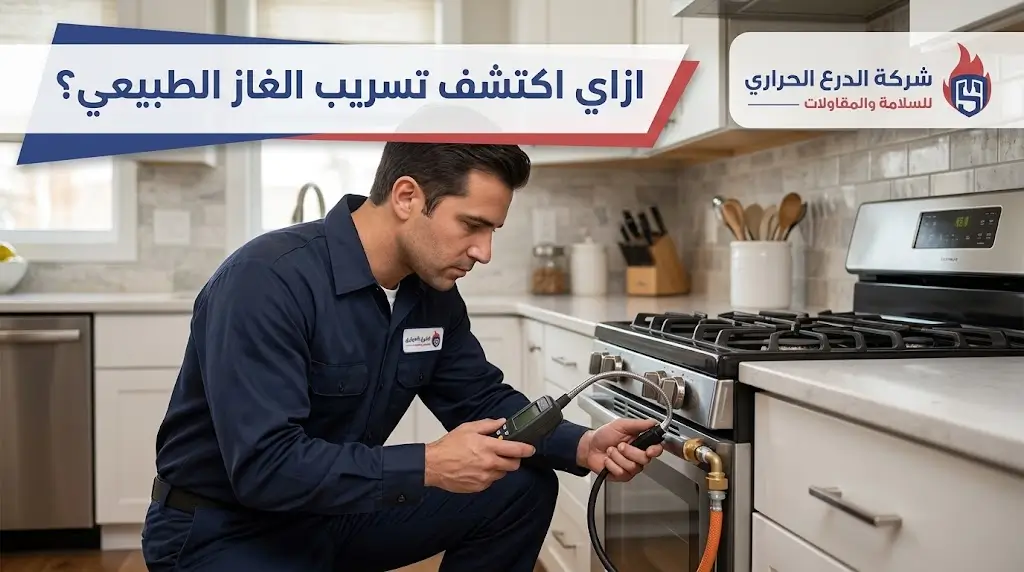
Table of Contents
- Definitive Answer: How to Verify Gas Leaks in Seconds
- Sensory Indicators: How to Detect Hazards and Detection Methods
- Leak Testing Methods: Safe and Effective Soap and Water Solution
- Modern Technical Inspection: Electronic Sensors Without Destruction
- Oven Gas Leak Signs: Cooking Appliance Fault Indicators
- Comprehensive Comparison Matrix: Gas Leak Detection Methods
- Hidden Risks: Securing Piping and Main Valves Without Structural Damage
- Proper Action Upon Leak Detection: Critical Emergency Protocol
- Early Warning Alarms: Importance of Smart Gas Detectors
- Role of Routine Maintenance in Preventing Leaks and Protecting Families
- Common Mistakes When Dealing with Gas Odors and How to Avoid Them
- Why Certified Experts Are Your Safest Choice for Facility Safety
- Related Guides and Articles on Thermoshield Platform
- Frequently Asked Questions Regarding Natural Gas Leaks
- Next Step to Total Safety: Request Certified Engineering Inspection Now
Call Us |
How to Verify Gas Leaks in Seconds? (Direct Safety Protocol)
Immediate gas leak verification occurs through 3 consecutive steps: smelling rotten eggs (added mercaptan odorant), hearing a continuous hiss or whistle near connections, and monitoring indoor plants that wither suddenly. For quick localized confirmation, wipe suspicious joints with soap and water solution; if bubbles inflate and multiply, this confirms an active, active leak.
[Sensory Smell / Sound] ──> [Soap Foam Test] ──> [Shut Main Valve Without Touching Electricity]
Sensory Indicators: How to Detect Hazards and Methods of Discovery
Initial gas leak detection relies on careful attention to direct sensory signals and environmental cues surrounding supply points. Natural gas in its raw form lacks color or odor, which is why industrial regulations require utility companies to inject chemical Mercaptan giving it a pungent, repulsive sulfur odor resembling rotten eggs, allowing humans to detect it via nose even at trace concentrations starting from 1% of room air volume.
Critical sensory and environmental indicators include:
- The Olfactory Test: Emitting a sulfur odor increasing in concentration near ovens, water heaters, or lower kitchen cabinets where supply pipes pass.
- Acoustic Signs: Hearing a soft, continuous hiss or whistle originating behind appliances or control valves, resulting from pressurized gas escaping a microscopic pinhole or loose fitting.
- Visual Indicators: Observing unexplained dust or debris dispersion at specific floor points or localized air movement fluctuation near conveyance lines.
- Sudden Houseplant Death: Withering and yellowing of green plants near gas lines because methane gas displaces soil oxygen and destroys live roots rapidly.
- Sudden Physical Symptoms: Occupants experiencing sudden headaches, dizziness, nausea, shortness of breath, or eye burning—direct signs of oxygen depletion and hydrocarbon space saturation.
Safe and Effective Soap and Water Solution Test for Precise Leak Location
The soap and water bubble test is the most reliable and safe manual method recommended by the American Gas Association (AGA) for inspecting external connections. This principle surrounds leakage points with a viscous membrane barrier preventing gas from dissipating without trapping it inside visible bubbles.
Steps for field test preparation and application:
- Prepare Active Solution: Mix one-third cup of high-foam dish soap with two-thirds cup of warm water to obtain a homogenous liquid capable of forming a dense, stable soapy layer.
- Clean Target Joints: Wipe accumulated dust around valves, brass fittings, and elbows to ensure foam adhesion to metal surfaces.
- Apply Solution Carefully: Dip a soft paintbrush or clean sponge into the solution, passing it gently across the entire mechanical joint perimeter, including threaded unions and flexible supply hoses.
Results Analysis:
- Confirmed High-Risk Leak: Formation of growing air bubbles stacking rapidly (Continuous Foaming).
- No Leak: Soapy liquid remains stable and slips downward without forming expansion foam.
- Rinse Joint: Wipe the pipe with a clean damp cloth afterward to prevent metal corrosion from salt residues over the long term.
Electronic Sensors for Non-Destructive Leak Detection in Walls and Floors
Smart buildings and commercial facilities require advanced inspection of pipes buried inside concrete slabs and drop ceilings. Here, standards approved on the Thermoshield platform shine by answering professionally how to detect natural gas leaks without destruction in upscale architectural finishes.
Modern digital devices rely on advanced measurement mechanisms eliminating randomness:
- Semiconductor Sniffers: Handheld units with a flexible gooseneck probe equipped with high-sensitivity sensors for methane and ethane molecules, measuring leaks in Parts Per Million (PPM) and localizing pinholes behind joints with millimeter precision.
- Ultrasonic Leak Detectors: Capturing microscopic high-frequency sounds inaudible to human ears generated by high-pressure gas friction across pinhole edges, converting them into optical and digital signals on inspection screens.
- Optical Gas Imaging (OGI) Cameras: Specialized spectral thermal cameras enabling engineers to view transparent leaking gas clouds as dark rising smoke on screen in real time.
- Digital Differential Manometers: Isolating gas networks and applying hydrostatic or pneumatic pressure testing; minor pressure drop readings during specific timeframes indicate internal leaks within hidden pipe pathways.
Call Us |
Cooking Appliance Fault Indicators and Incomplete Combustion Risks
Kitchens account for the largest share of gas incidents due to faulty ovens, stoves, or stiff rubber hoses over time and high temperatures. If you wonder how to detect natural gas leaks originating from cooking ranges, technical indicators signal flaws before escalation:
- Flame Color Shift:
- Normal Condition: Stable, centered blue flame indicating complete combustion and proper gas-air mixing.
- Hazard Condition: Intermittent, tall yellow or orange flame, signaling lack of ventilation, clogged burners, and incomplete combustion generating toxic carbon monoxide ($CO$).
- Delayed Ignition (“Pop”): Hearing a pop or minor explosion sound inside the oven during ignition attempts, implying unburned gas accumulation before spark arrival.
- Soot Deposits: Black carbon layers forming on cookware, burner tips, or walls adjacent to the stove.
- Abnormal Rotary Switch Heat: Excessive heat in control knobs or oven fronts during operation, indicating internal flame or gas leakage around valve paths.
- Constant Pilot Light Extinction: Continuous thermocouple failure or supply line blockage, allowing gas flow without ignition.
Comparison Matrix: Traditional vs. Modern Technical Gas Leak Methods
| Comparison Metric | Odor Sensing (Mercaptan) | Soap and Water Foam Test | Portable Electronic Sensors | Manometric & Ultrasonic Systems |
|---|---|---|---|---|
| Application Type | Urgent initial inference | Localized visible joint check | Precise scan of joints & appliances | Buried structural line inspection |
| Location Accuracy | Very low (area only) | High on external surfaces | Ultra-precise (Parts Per Million PPM) | Absolute (micro-leaks and lines) |
| Non-Destructive | Yes | Yes (exposed pipes only) | Yes (via ports and openings) | 100% inside concrete slabs |
| Error Probability | High (olfactory fatigue) | Possible on microscopic holes | Very low, depends on calibration | Near zero, engineering readouts |
| Safety During Test | Low during prolonged exposure | Completely safe | Safe and explosion-proof (ATEX) | Highest engineering safety level |
| Cost & Complexity | Free and instant | Low and easy to apply | Moderate, specialized units | Requires certified engineering team |
Hidden Risks: Securing Piping Connections and Main Valves Without Structural Damage
True disasters stem from hidden leaks originating beneath floors or inside wall cavities due to thermal expansion stress, slight soil settlement, or galvanized pipe corrosion. To verify building supply structural integrity without disrupting décor and concrete, Thermoshield consultants (thermoshield.sa) rely on:
- Static Meter Test: Shutting off all gas-consuming appliances completely while keeping the main valve open. Monitor mechanical meter indices or digital displays precisely for 30 to 60 minutes; if numbers move during shutdown, this proves mathematically that loss and leakage exist within buried internal networks.
- Central Valve Insulation Check: Inspecting quick-shutoff ball valves to ensure zero internal leakage across valve seats, verifying handle flexibility and instant flow cutoff.
- Tracer Gas Technique: Purging gas lines and injecting a safe non-flammable mixture of 95% nitrogen and 5% hydrogen under controlled pressure, using hydrogen sensors tracking pathways above tiles and flooring. Light hydrogen molecules penetrate smallest pores to be detected above with astonishing precision without breaking a single ceramic tile.
Proper Action Upon Gas Leak Detection: Critical Emergency Evacuation Protocol
Knowing detection methods is incomplete without rigorous execution of instant safety procedures. Once hazard is confirmed, execute this protocol without delay:
[Immediate Evacuation] ──> [Shut Main Valve] ──> [Natural Ventilation (Open Windows)] ──> [Call Emergency from Open Area]
- Step One: Prevent Electrical Sparks: Do not touch light switches (turning on or off), do not unplug appliances, avoid kitchen extractor fans, and do not use mobile phones inside gas-saturated spaces. Electrical switches generate microscopic arcing sufficient to ignite accumulated gas.
- Step Two: Lock Main Supply Source: Move directly to the building master gas valve or central cylinder, turning the handle a quarter turn perpendicular to pipe alignment to halt flow permanently.
- Step Three: Maximum Natural Ventilation: Open surrounding doors and windows fully allowing gas to dissipate and replace with fresh air, relying strictly on natural airflow and avoiding portable electric fans.
- Step Four: Organized Immediate Evacuation: Exit the facility calmly with all family members or staff, avoiding running or elevator use.
- Step Five: Request Specialist Support: Call approved utility emergency numbers or Civil Defense only after moving to a safe outdoor distance of at least 50 meters.
Importance of Installing Smart Gas Detectors in Facilities
Smart alarm systems represent permanent safety valves monitoring spaces 24/7, capable of sensing gas before human olfaction thresholds or lower explosive limits (LEL).
Benefits of integrating smart gas detectors into safety plans:
- Auto-Shutoff Solenoid Valves: Detectors link to electromagnetic valves on main lines; upon sensing leaks, sensors send instant electrical pulses closing valves mechanically and shutting off source supply.
- Powerful Audio-Visual Alarms: Emitting 85+ dB sirens with flashing strobes to wake sleeping occupants and alert bystanders.
- IoT Smartphone Integration: Sending live emergency alerts to owner smartphones or monitoring control rooms during vacancy leaks.
Role of Routine Maintenance in Preventing Leaks and Protecting Families and Assets
Facility owners should not wait for disasters to ask how to detect natural gas leaks; prevention must precede hazard flags. Routine maintenance of piping networks, heater flues, and stove nozzles ensures operating pressure stability, identifies heat-induced rubber joint cracking, and renews thread sealants (Teflon Tape / Gaskets) before degradation.
Scheduled engineering inspection programs reduce silent leak risks by over 98%, extending feeding network and thermal appliance lifespans while preserving residential and commercial kitchen safety per regulatory standards.
Common Mistakes When Dealing with Gas Odors and How to Avoid Them
When individuals search frantically during panic moments for how to detect natural gas leaks, flawed actions accelerate explosions rather than containing them:
- Turning on Exhaust Fans for Ventilation: A destructive mistake; standard extractor motors are non-explosion proof and generate internal frictional sparks during rotation, igniting absorbed gas clouds.
- Using Mobile Phones Near Leaks: Phones contain batteries and electronic circuits capable of micro-static discharge sufficient for ignition.
- Testing with Matches: One of the deadliest errors; testing joints with fire causes flame flashback inside pipes or triggers accumulated gas explosions.
- Ignoring Faint Odors as Transient: Recurrent gas odors signify continuous venting accumulating gradually until hazard thresholds are reached; never leave odors without engineering resolution.
Why Certified Experts Are Your Safest Choice for Facility Safety
Despite initial preventive steps, the specialist question remains: how to detect natural gas leaks with absolute accuracy relieving legal liability and ensuring family or facility security? The answer always lies in certified professional inspections. Certified engineers at Thermoshield (thermoshield.sa) possess advanced digital measuring and calibration equipment alongside engineering expertise verifying supply networks per international fire safety codes.
Certified engineering inspections include pipe thickness measurements, network pressure balance analysis, alarm and automatic valve calibration, and compliance verification with civil protection standards, granting total peace of mind and reliable safety certificates.
Frequently Asked Questions
What is the distinctive odor of natural gas during a leak?
Natural gas is naturally odorless, but artificially spiked with sulfurous “Mercaptan” giving it a repulsive rotten egg odor allowing anyone to smell it immediately even at lowest leak levels.
Can a lighter or match be used to search for a leak location?
Strictly prohibited. Using open flame to search for leaks poses lethal hazards, triggering direct destructive explosions and immediate ignition of gas-saturated spaces upon reaching flammable concentrations.
What should I do immediately upon smelling gas inside the kitchen?
Shut the main gas valve immediately, open windows for natural ventilation, refrain entirely from touching electrical switches or operating extractors, evacuate the building, and contact competent authorities from a safe outdoor area.
Does a yellow or orange flame in the oven indicate danger?
Yes, safe healthy flames are pure blue. Yellow or orange flames with smoke mean incomplete gas combustion and toxic carbon monoxide emissions, requiring device shutdown and nozzle inspection.
How do smart electronic gas leak detectors work?
They rely on electrochemical or infrared sensors measuring air gas ratios; when concentration hits set thresholds, they trigger sharp alarms and send electrical signals to automatic valves closing supply lines instantly, alerting users via smartphones.
What is the safest preventive procedure for a full facility inspection?
The most reliable procedure answering how to detect natural gas leaks conclusively across all facility corners and avoiding silent hazards is scheduling comprehensive recurring gas network and valve checks using electronic detection and hydraulic pressure via certified engineers at Thermoshield (thermoshield.sa).
Call Us |
Conclusion
Natural gas safety tolerates neither postponement nor random experimentation. If you wish to secure your home, restaurant, or commercial facility against invisible threats and ensure piping integrity without destruction, contact Thermoshield experts today (thermoshield.sa). We provide advanced technical solutions, certified smart sensors, and a specialized engineering team ensuring 24/7 protection of lives and facilities under highest certified safety standards.