
Engineering protection for advanced technical assets requires clean agent fire suppression solutions that avoid water flooding or dry chemical powders, which destroy electronic systems and halt business operations. FM200 automatic fire suppression systems serve as the ultimate safety valve and foundational pillar for securing data centers, telecommunication exchanges, server rooms, and critical sites through fast-acting clean gas technology with zero environmental or physical residue.
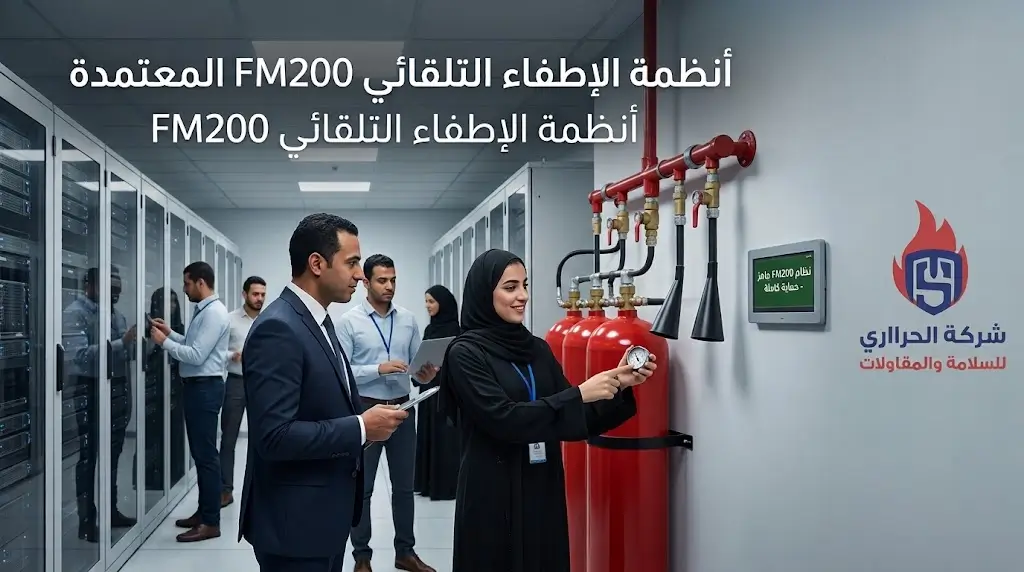
Table of Contents
- Definitive Answer: What Are FM200 Automatic Fire Suppression Systems?
- Technical Framework: What Is FM200 Gas (HFC-227ea / Heptafluoropropane)?
- Core Components of FM200 Suppression Systems
- Central Control Panel and Early Detection Alarm Systems
- Ideal Applications for Automatic FM200 Systems
- Operational Characteristics: Suppression Speed and Sensitive Equipment Protection
- Environmental and Human Safety Standards and Safe Concentration Limits
- Technical Comparison: FM200 System vs. Carbon Dioxide (CO2) System
- Engineering and Regulatory Standards: NFPA 2001 and Saudi Code SBC 801
- Standard Mathematical Equation for Volumetric Gas Quantity Sizing
- Costs, Maintenance, and Room Integrity Door Fan Testing
- Why Choose Thermoshield Engineering Solutions?
- Related Guides and Technical Articles
- Official Reference Standards and Authorities
- Frequently Asked Questions Regarding FM200 Systems
- Engineering Consultation and Quotation Requests
Call Us |
FM200 Automatic Fire Suppression Systems Definition
FM200 automatic fire suppression systems are clean agent extinguishing setups utilizing heptafluoropropane to inhibit fires in under 10 seconds without depleting oxygen levels or leaving chemical residues. These systems absorb thermal energy from the fire triangle through advanced physical and chemical mechanisms, serving as the global standard for protecting occupied rooms and sensitive electronic equipment under NFPA 2001 and Saudi Fire Code SBC 801 standards while ensuring electrical non-conductivity.
Technical Framework: What Is FM200 Gas (HFC-227ea / Heptafluoropropane)?
FM200 gas, scientifically known as heptafluoropropane with chemical formula CF3-CHF-CF3 (HFC-227ea), is an organic gaseous compound containing fluorine, carbon, and hydrogen atoms. It is odorless, colorless, entirely non-conductive, and stored as a liquefied gas under dry nitrogen pressure at industrial purity levels.
                  F   F   F
                  |   |   |
              F - C - C - C - F
                  |   |   |
                  F   H   F
          (Heptafluoropropane / HFC-227ea)
The extinguishing mechanism differs fundamentally from oxygen-depleting systems, operating via two simultaneous pathways:
- Physical Mechanism (Thermal Absorption): Accounting for over 80% of the extinguishing capacity, the gas features a high specific heat capacity that absorbs flame thermal energy, reducing the ignition zone temperature below the threshold required for sustained combustion.
- Chemical Mechanism (Free Radical Scavenging): Accounting for the remaining ~20%, slight thermal decomposition generates free radical molecules that chemically interfere with the flame chain reaction, neutralizing active free radicals like ($OH^{\bullet}$) and ($H^{\bullet}$) to halt fires instantly.
Upon discharge from nozzles, the pressurized liquid converts into a homogenous vapor gas without causing thermal shock to sensitive microchips inside server racks or inducing internal moisture condensation.
Core Components of FM200 Suppression Systems
The infrastructure of an FM200 system relies on precise mechanical and hydraulic integration designed to withstand sudden operating pressures:
[Alarm & Suppression Control Panel]
   │
   ├── (Optical Smoke Detector Zone A) ── (Thermal Detector Zone B) -> [Cross-Zoning]
   │
   └── [Electric Solenoid Actuator]
            │
      [Pressurized FM200 Cylinder]
            │
     [Differential Pressure Valve]
            │
      [Sch 40 Piping Network]
            │
     [360° / 180° Discharge Nozzles]
- Storage Cylinders and Fast Discharge Valves: Manufactured from high-strength alloy steel compliant with ASTM and ASME standards. Gas is stored as a liquid under self-balancing pressure, super-pressurized with dry nitrogen ($N_2$) to a nominal operating pressure of 25 bar (360 psi) or 42 bar (600 psi). A differential pressure valve is mounted on the cylinder outlet, actuated automatically via solenoid or manually, and equipped with a pressure gauge and supervisory pressure switch.
- Modular Piping Network: Subjected to rigorous hydraulic calculations to distribute gas through variable diameters maintaining pressure stability. Standards mandate seamless carbon steel pipes compliant with ASTM A106 Grade B or ASTM A53 with a minimum Schedule 40 thickness, paired with malleable iron (300 lb) or galvanized fittings.
- Advanced Discharge Nozzles: Engineered discharge nozzles provide complete volumetric coverage without dead zones. Available in 360° (center-mounted) and 180° (wall-mounted) configurations, each nozzle features orifices hydraulically calibrated via specialized calculation software to atomize the agent into a dense fog that rapidly vaporizes across the enclosure.
Central Control Panel and Early Detection Alarm Systems
FM200 automatic suppression systems operate via smart gas release control panels utilizing Cross-Zoning Logic to prevent accidental discharge:
- Zone A (First Zone): Incorporates photoelectric smoke detectors or Aspirating Smoke Detectors (ASD) to detect incipient combustion particles, triggering a pre-alarm without agent release.
- Zone B (Second Zone): Incorporates thermal or secondary smoke detectors. Upon activation alongside Zone A, immediate release sequencing initiates: sounding Horn/Strobe alarm signals, shutting down HVAC units and closing Fire Dampers mechanically, cutting critical electrical power feeds to suspect circuits, and initiating a 30 to 60-second evacuation countdown before agent flooding.
Manual release pull stations are positioned near doors to bypass countdown timers during extreme emergencies, alongside abort switches allowing personnel to halt discharge if a false alarm is verified before countdown expiration.
Call Us |
Ideal Applications for Automatic FM200 Systems
Facility profiles demanding FM200 installations as a mandatory engineering standard include:
- Data Centers & IT Rooms: Protecting digital assets and server continuity where downtime costs outweigh equipment replacement.
- MCC & Switchgear Rooms: Shielding electrical connections from fire without risking sudden electrical flashover.
- Telecom Switching Centers: Preventing physical destruction of switching towers and routing hardware.
- National Archives and Rare Manuscript Warehouses: Preserving historical paper, leather, and documents from liquid or powder damage.
- Museums, Art Galleries, and Vaults: Safeguarding paintings and artifacts without chemical degradation.
- Pharmaceutical Laboratories and Cleanrooms: Protecting equipment without disrupting sterile biological environments.
Operational Characteristics: Suppression Speed and Sensitive Equipment Protection
The reliability of FM200 systems stems from suppressing fires during the incipient stage via key operational features:
- Standard Discharge Speed: Discharging full volume within 10 seconds prevents cumulative room temperature spikes, halting thermal breakdown of data cable plastics and toxic corrosive emissions.
- Zero Residue: Unlike water or powder, FM200 vaporizes completely, leaving surroundings dry and clean immediately after natural ventilation, allowing operations to resume instantly.
- Absolute Electrical Safety: HFC-227ea features a dielectric strength exceeding air, making direct discharge onto live energized server hardware completely safe without short circuits.
Environmental and Human Safety Standards and Safe Concentration Limits
Physiological impacts are governed by the US EPA Significant New Alternatives Policy (SNAP). FM200 has an Ozone Depletion Potential of zero ($ODP = 0$). For occupied spaces, safety thresholds are established as follows:
- Design Concentration: Typically ranges between 6.25% and 9.0% by volume for Class A and C fires.
- No Observed Adverse Effect Level (NOAEL): Set at 9.0% by volume, presenting no adverse or cardiac sensitization effects on humans.
- Lowest Observed Adverse Effect Level (LOAEL): Set at 10.5% by volume.
Because design concentrations in server rooms remain below NOAEL values, personnel presence during discharge poses no risk of asphyxiation or toxicity.
Technical Comparison: FM200 System vs. Carbon Dioxide (CO2) System
Engineering evaluations require distinguishing between clean agent FM200 and high-pressure carbon dioxide systems:
| Technical Comparison Metric | FM200 Suppression System | Carbon Dioxide (CO2) System |
|---|---|---|
| Active Agent | Heptafluoropropane ($C_3HF_7$) | Carbon Dioxide ($CO_2$) |
| Primary Extinguishing Mechanism | Physical thermal absorption & chemical inhibition | Oxygen displacement below 15% (Smothering) |
| Occupied Space Safety | Completely safe at standard concentrations (< 9%) | Lethal to humans (Discharges cause asphyxiation) |
| Standard Discharge Time | Maximum 10 seconds | Ranges from 60 to 120 seconds |
| Standard Storage Pressure | 25 to 42 bar (360 – 600 psi) | High pressure: 58 to 65 bar (850+ psi) |
| Effect on Sensitive Hardware | No thermal shock, safe and non-damaging | Causes severe thermal shock and frost condensation |
| Cylinder Storage Footprint | Compact storage footprint, fewer cylinders | Requires large banks of high-capacity cylinders |
| Optimal Application | Data centers, server rooms, control hubs | Unoccupied generator rooms and transformer vaults |
Engineering and Regulatory Standards: NFPA 2001 and Saudi Code SBC 801
Design and installation adhere to rigorous local and global standards:
- NFPA 2001 (Standard on Clean Agent Fire Extinguishing Systems): The benchmark governing clean agent requirements, specifying agent quantity formulas based on minimum site temperatures, fuel types, and piping test procedures.
- Saudi Fire Code (SBC 801): Issued by the National Committee for Saudi Building Code, mandating clean agent suppression systems in data centers and electrical control rooms, ensuring integration with master fire alarms and compliance with SASO and UL/FM listings.
Standard Mathematical Equation for Volumetric Gas Quantity Sizing
Agent sizing per NFPA 2001 Chapter 5 depends on net enclosure volume and expected design temperature:
$$W = \frac{V}{S} \cdot \left( \frac{C}{100 – C} \right)$$
Where variables represent:
- $W$: Net required FM200 agent mass in kilograms ($kg$).
- $V$: Net geometric volume of the protected room in cubic meters ($m^3$).
- $C$: Design volumetric concentration percentage required based on hazard type.
- $S$: Specific vapor volume at design temperature ($m^3/kg$), calculated as $S = k_1 + (k_2 \cdot T)$ where $k_1 = 0.1269$ and $k_2 = 0.000513$ for HFC-227ea, and $T$ represents minimum expected room temperature ($^\circ C$).
Costs, Maintenance, and Room Integrity Door Fan Testing
System integrity extends beyond installation to ongoing storage efficiency and enclosure sealing:
- FM200 System Cost and Refilling Services: Influenced by net room volume, operating pressure, and piping run lengths. Refilling requires certified high-purity HFC-227ea accompanied by Certificates of Analysis (CoA), executed via Civil Defense-approved recharging stations under dry nitrogen pressure.
- Routine Maintenance and Hydrostatic Pressure Tests: Semi-annual checks review cylinder pressure gauges and agent weights (recharging required if weight drops over 5%). Annual checks service electrical signal lines and control panels. Hydrostatic pressure re-testing of cylinders is mandatory every 5 to 10 years per DOT/CGA specifications.
- Room Integrity Testing (Door Fan Test): A mandatory requirement per NFPA 2001. A specialized fan assembly is mounted on room doors to measure leakage rates and differential pressure, verifying that the enclosure retains design concentration at 75% of protected height for at least 10 minutes (Hold Time).
Call Us |
Why Choose Thermoshield Engineering Solutions?
Thermoshield Safety & Contracting Company serves as the certified engineering partner for government, industrial, data center, and telecom sectors across Saudi Arabia:
- Specialized Consulting Teams: Certified engineers executing hydraulic calculations and flow modeling accurately to prevent financial waste and ensure maximum protection.
- Complete Civil Defense Compliance: Providing UL Listed and FM Approved products complying with SBC 801 fire codes to expedite municipal and safety licensing.
- Direct Supply and Maintenance Facilities: Equipped stations for cylinder recharging, testing, and maintenance, stocked with original spare parts and quick-release actuators.
- Integrated Field Services: Executing certified Door Fan Integrity testing, issuing calibration and warranty certificates backed by extended annual maintenance contracts.
Related Guides and Technical Articles
- What Are the Types of Fire Pumps: Comprehensive Engineering Guide
- How Are Fire Pumps Calculated? Hydraulic Sizing Guide
- Civil Defense License Cost and Salamah Platform Fees Guide
- Engineering Requirements for Server Rooms and Data Centers per SBC 801
- Routine Maintenance Protocols and Pressure Testing for Gas Suppression Cylinders
- Analysis of Saudi Fire Code SBC 801 and Civil Defense Requirements
Official Reference Standards and Authorities
- National Fire Protection Association (NFPA): NFPA 2001 (Clean Agent Fire Extinguishing Systems) and NFPA 72 (National Fire Alarm and Signaling Code).
- National Committee for Saudi Building Code (SBC): Saudi Fire Code (SBC 801).
- General Directorate of Civil Defense in Saudi Arabia: Executive regulations and technical requirements for automatic fire suppression networks.
- Underwriters Laboratories and Factory Mutual (UL/FM): International listings and standards for fire suppression equipment.
Frequently Asked Questions Regarding FM200 Systems
What is the physical and chemical principle of fire extinguishment using FM200 gas?
Heptafluoropropane absorbs thermal energy from fire flames exceeding 80% physically, while chemically inhibiting the chain reaction by roughly 20%, extinguishing fires in under 10 seconds without oxygen depletion.
Is FM200 gas completely safe for humans in occupied spaces?
Yes, the gas is completely safe when used at standard design concentrations certified by NFPA 2001 ranging between 6.25% and 9%, remaining well below the No Observed Adverse Effect Level (NOAEL) of 9.0% by volume.
What is the allowable standard discharge time for FM200 systems?
NFPA 2001 mandates a full gas discharge duration not exceeding 10 seconds from electrical valve actuation to suppress flames before reaching thermal decomposition stages.
Why are water sprinkler systems unsuitable for server rooms and data centers?
Water causes direct physical damage to micro-connections and printed circuit boards, triggering immediate short circuits, whereas FM200 discharges as a non-conductive clean gas that evaporates entirely without residue.
What is the purpose of the Door Fan Integrity Test in FM200 rooms?
The test measures room airtightness and leakage rates to verify that the protected enclosure can retain design gas concentration for at least 10 minutes (hold time) to prevent re-ignition.
What are the core differences between FM200 and Carbon Dioxide (CO2) systems?
Carbon Dioxide extinguishes fires by displacing oxygen below 15%, making it lethal to humans, whereas FM200 extinguishes via thermal absorption while maintaining safe oxygen concentrations for breathing.
Engineering Consultation and Quotation Requests
Obtain an integrated design and setup for FM200 clean agent fire suppression systems matching your project specifications and Saudi Civil Defense requirements through specialized consultants at Thermoshield.
Contact the certified engineering team at Thermoshield today to request site inspections, hydraulic calculations, and installation planning.