
A fire pump alone cannot protect a facility from fire hazards; the difference between a firefighting system that performs reliably during emergencies and one that fails at a critical moment rarely depends solely on pump capacity. Rather, it hinges on pump classification and its alignment with hydraulic network design and available water infrastructure. This raises a primary question for facility owners and contractors prior to installation: types of fire pumps and how to select the optimal model for a building, as well as why most installations require multiple pumps working in an integrated assembly.
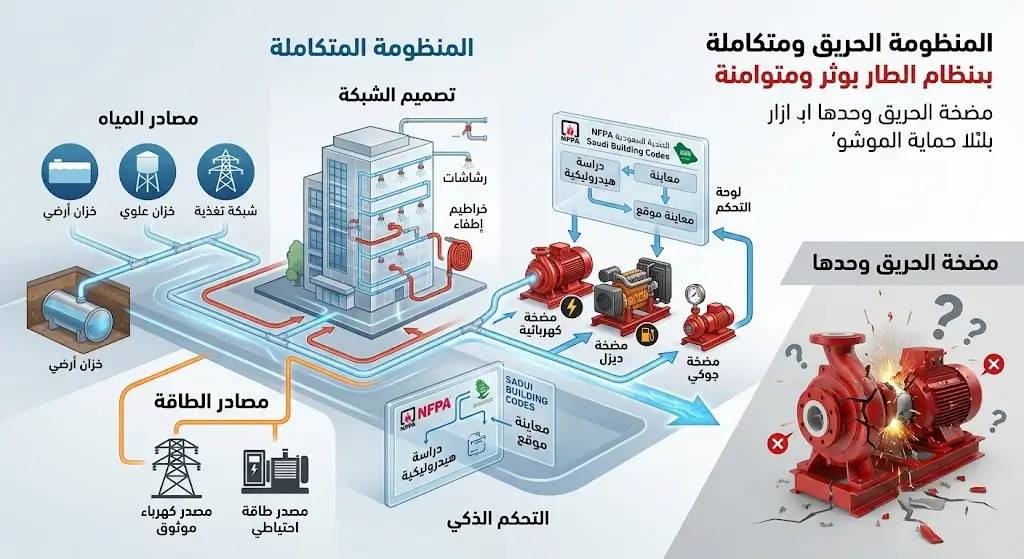
Table of Contents
- What are the Types of Fire Pumps by Power Source?
- What are the Types of Fire Pumps by Mechanical Design?
- How Do Fire Pumps Operate Together in a Single System?
- What are the Core Components of a Complete Fire Pump Room?
- What are the Selection Criteria for Fire Pump Types?
- What are the Reference Codes and Standards for Fire Pumps?
- What are the Common Mistakes When Selecting Fire Pumps?
- How are Periodic Inspections and Maintenance Conducted?
- Frequently Asked Questions About Types of Fire Pumps
- Conclusion
📞 Call Us |
What are the Types of Fire Pumps by Power Source?
Driver classification is a fundamental criterion in fire pump room design, ensuring a reliable power source sustains water delivery during emergencies to satisfy متطلبات الأمان والسلامة. Primary configurations include:
What is an Electric Motor Fire Pump?
An electric fire pump is driven by a dedicated electric motor connected directly to the primary power infrastructure. Key benefits include rapid startup response and straightforward routine maintenance compared to fuel-driven sets, requiring no on-site fuel storage or internal combustion engine upkeep.
However, its reliance on utility power makes it vulnerable to grid outages during structural fires, explaining why medium-to-large facilities must provide an independent secondary power source or auxiliary standby driver.
What is a Diesel Engine Fire Pump?
A diesel fire pump utilizes an autonomous internal combustion engine independent of the electrical grid, maintaining uninterrupted operation during total facility blackouts—a crucial capability during severe emergencies.
Diesel units require dedicated fuel day-tanks, dual battery cranking systems, and rigorous preventive maintenance, including regular oil, filter, and cooling system audits to guarantee instantaneous starting.
Diesel drivers generally serve as secondary backup units alongside primary electric pumps, or act as primary drivers in remote locations lacking reliable utility feeds to fulfill statutory life safety requirements.
What is a Jockey Pump (Pressure Maintenance Pump)?
A jockey pump is a fractional-horsepower, low-flow pump distinct from direct suppression duty. It maintains continuous static pressure within the distribution network, compensating for minor leakage or temperature variations.
Integrating a jockey pump prevents short-cycling of primary electric or diesel pumps on minor pressure drops, protecting primary drivers from premature wear and ensuring they remain reserved for genuine fire incidents.
What are the Types of Fire Pumps by Mechanical Design?
Evaluating mechanical types of fire pumps highlights how casing geometry and internal mechanics align with water source depth and physical room dimensions:
What is an End Suction Centrifugal Pump?
End suction pumps are widely utilized across medium commercial and الأمن الصناعي industrial applications, where water enters axially through the end nozzle and discharges radially upward through an engineered volute.
They offer straightforward installation and maintenance, serving facilities fed by positive suction water tanks or engineered municipal supply headers.
What is a Horizontal Split Case (HSC) Pump?
Horizontal split case pumps are standard in large industrial developments, logistics parks, and high-occupancy structures demanding high water flow volumes.
Their split-casing design allows maintenance teams to access the impeller, bearings, and shaft by removing the upper casing half without disconnecting external suction and discharge pipework.
What is a Vertical Turbine Pump?
Vertical turbine pumps are specifically engineered to lift water from sources located below the pump centerline, such as deep wells, sub-grade sumps, or below-ground suction reservoirs, with submerged bowl assemblies connected to a surface-mounted driver.
This model is specified when the available water supply cannot provide flooded suction for horizontal pumps, with suitability verified through site-specific hydraulic analysis.
What is an In-Line Centrifugal Pump?
In-line pumps feature a compact footprint and install directly into piping runs, eliminating the need for large concrete inertia bases required by heavier horizontal sets.
They suit space-restricted mechanical rooms, though their application depends on hydraulic demand limits and they cannot replace high-flow primary pumps in major facilities.
Pump selection requires certified hydraulic calculations accounting for design flow in GPM, required residual pressure at remote nozzles, and net positive suction head (NPSH), executed by a licensed fire protection engineer.
📞 Call Us |
How Do Fire Pumps Operate Together in a Single System?
A standard firefighting network relies on a coordinated multi-pump package operating in an automated sequence:
When a minor pressure drop occurs, the jockey pump starts automatically to restore baseline levels. If system pressure continues to drop due to an activated sprinkler head or landing valve, the primary electric fire pump starts automatically to deliver full rated demand.
In systems with dual drivers, the diesel engine pump starts automatically if the electric power supply fails or the primary unit faults, sustaining water flow per controller programming.
This staged arrangement ensures redundancy and system reliability, with pump sizing and room layout defined per applicable codes for Civil Defense licensing approval.
What are the Core Components of a Complete Fire Pump Room?
A pump operates within an integrated mechanical enclosure equipped with essential control and safety devices:
- Fire Pump Controller: Automates driver startup, monitors line pressure transducers, and logs fault diagnostics.
- Isolation Valves (OS&Y / Butterfly): Supervised indicating valves that isolate components during maintenance without draining the main network.
- Main Pressure Relief Valve: Regulates excess discharge pressure in diesel installations to protect distribution piping.
- Casing Relief Valve: Discharges a small water stream during churn operation to prevent overheating of centrifugal pump casings.
- Electrical Power Feeder: Delivers dedicated, fire-rated electrical service to the electric motor controller.
- Fuel Storage & Batteries: Dedicated day-tanks and dual industrial battery racks dedicated to diesel engine cranking.
Each auxiliary component performs a critical function; improper installation or deferred maintenance on any element can compromise overall emergency performance.
What are the Selection Criteria for Fire Pump Types?
Selecting an appropriate fire pump depends on comprehensive engineering parameters rather than overall building floor space alone:
Available Water Source
Determining whether the water supply originates from an aboveground tank, buried suction reservoir, gravity tank, or deep well directly dictates whether a horizontal centrifugal or vertical turbine pump is required.
Power Infrastructure Reliability
Utility grid reliability and the availability of on-site backup generators determine driver configuration, including the necessity of a dedicated diesel-driven backup pump.
Hydraulic Flow and Pressure Requirements
Engineers determine required flow in GPM and residual pressure at critical nodes based on occupancy hazard classification, hydraulic design density, and sprinkler coverage areas.
Facility Scale and Hazard Classification
A low-hazard residential building requires different hydraulic capacity than a heavy manufacturing plant or high-piled storage warehouse.
Decisions regarding types of fire pumps and sizing must be verified through stamped engineering drawings prepared by a qualified fire protection engineer.
What are the Reference Codes and Standards for Fire Pumps?
NFPA 20 (Standard for the Installation of Stationary Pumps for Fire Protection) governs pump types, driver configurations, and piping arrangements. NFPA 25 outlines mandatory inspection, testing, and maintenance procedures for water-based protection systems.
In Saudi Arabia, installations must comply with Saudi Building Code (SBC 801) fire safety regulations and Civil Defense statutory requirements to ensure smooth licensing renewals.
Final procurement and pump room layouts require an approved engineering blueprint, as hydraulic demands vary by hazard classification, water supply geometry, and system design.
What are the Common Mistakes When Selecting Fire Pumps?
Engineering and installation errors can compromise system dependability, including:
- Undersizing pump flow capacity relative to actual hydraulic network demand.
- Installing an electric pump alone without a backup driver when required by code.
- Omitting the jockey pump or improperly sizing its capacity.
- Selecting pump types without auditing actual suction water conditions.
- Overlooking churn and shutoff pressures during valve and piping selection.
- Neglecting periodic testing schedules per applicable codes.
- Deferring preventive maintenance on diesel engines, fuel systems, and batteries.
- Deviating from approved engineering drawings during installation, leading to inspection failures for safety licensing.
Resolving these issues during initial engineering prevents costly site retrofits and ensures compliance.
How are Periodic Inspections and Maintenance Conducted?
Long-term system reliability requires regular inspection and testing protocols:
- Weekly Visual Inspections: Verifying pump room conditions, controller displays, and checking for leaks or abnormal heat.
- Periodic Operational Tests: Running drivers to log startup and verify operating pressures per testing schedules.
- Diesel Engine Inspections: Checking fuel day-tank levels, lubricating oil quality, and battery charging health.
- Annual Full-Flow Testing: Performing comprehensive hydraulic flow tests across rated benchmarks per NFPA 25.
Maintaining accurate test logbooks verifies system performance and helps identify maintenance needs early.
Frequently Asked Questions About Types of Fire Pumps
What is the difference between diesel and electric fire pumps?
Electric fire pumps rely on incoming utility power to drive an electric motor. Diesel fire pumps operate via an autonomous internal combustion engine, providing an independent secondary water supply during total power blackouts.
Is a single fire pump sufficient to operate an entire firefighting system?
Pump configurations depend on hydraulic demand, building height, and code standards. Most commercial and industrial facilities require a primary pump, a standby backup pump, and a jockey pump.
When does a facility require a vertical turbine fire pump?
Vertical turbine pumps are required when the water supply is located below the pump centerline—such as in deep wells or below-ground suction basins—where flooded suction cannot be maintained.
What is the primary function of a jockey pump?
The jockey pump maintains static line pressure across the distribution network to compensate for minor leaks without cycling the main fire pumps unnecessarily.
Who determines the appropriate fire pump type and capacity for a building?
A licensed mechanical fire protection engineer determines pump specifications based on water source conditions, utility reliability, occupancy hazard level, and hydraulic calculations.
Can a facility rely solely on an electric fire pump?
Relying solely on an electric pump is permissible only when supported by an approved secondary utility substation or dedicated generator with an automatic transfer switch (ATS). Otherwise, an autonomous diesel pump is mandatory.
📞 Call Us |
Conclusion
Understanding the different types of fire pumps requires evaluating power sources, mechanical configurations, and how components integrate to deliver required water flow and pressure during an emergency.
Selecting an optimal pump package requires evaluating site water and power conditions, hydraulic flow and pressure demands, and hazard classification in compliance with NFPA standards and Civil Defense requirements.
To design, install, or audit fire pump systems for your facility, contact Thermoshield Safety and Contracting Company to review your project criteria and establish required technical scopes prior to execution.